
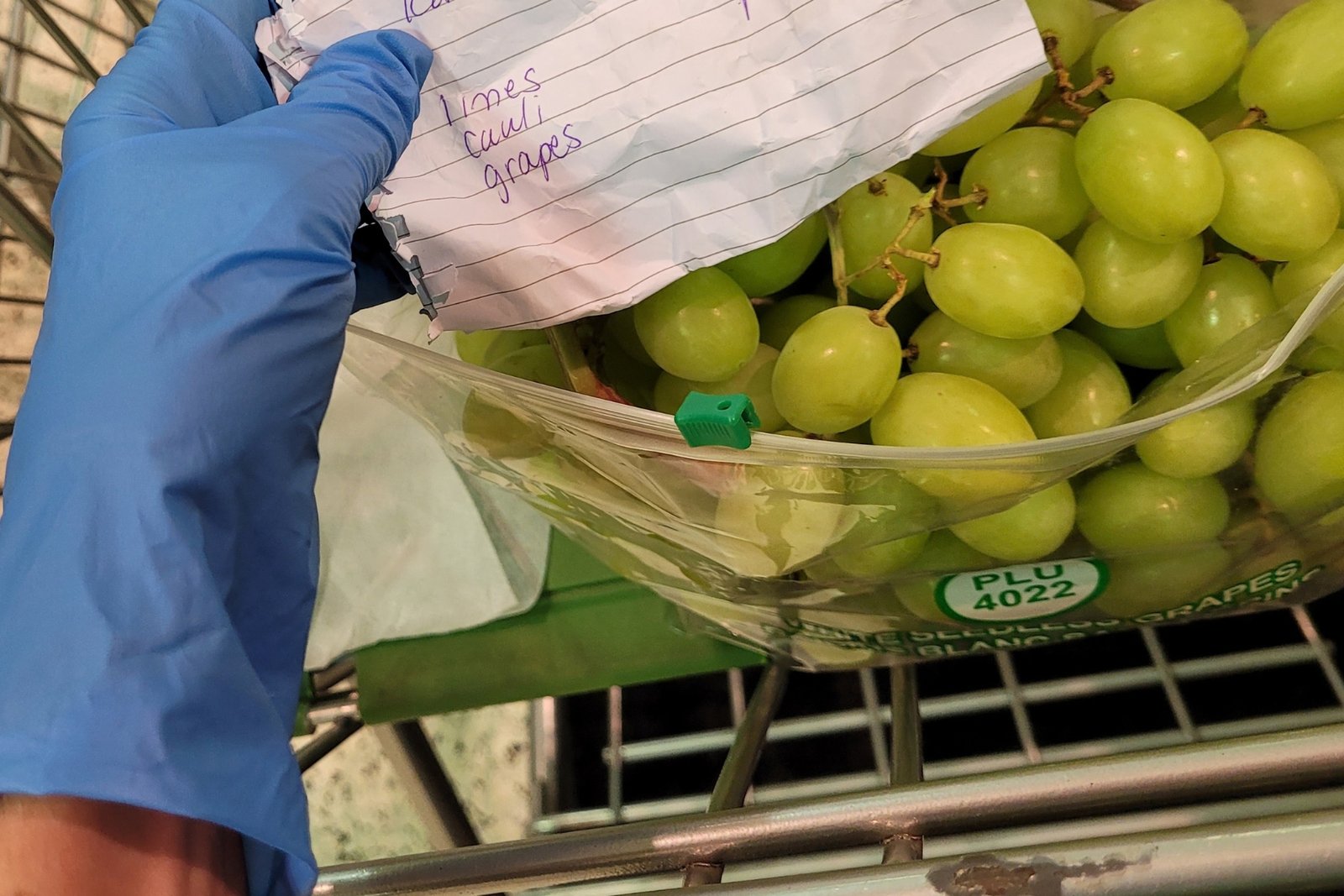
For about 2 and a half years, in my early days with end-stage liver disease, I was buying bags and bags of green grapes and eating them. Pounds of them. I did not know that sugar was bad for a liver like mine.
That is my hand in the photo at the top, during the pandemic. You can tell by the blue gloves. Face masks and gloves, we all remember those days. Those were conventional grapes, too. My shopping has changed a lot since then.
Looking back, I think part of it was that I reached for sugar after I stopped drinking. A lot of people do when they quit alcohol.
Then I saw a YouTube video that explained how sugary grapes are. I do not know exactly how I quit after that. That was GOD taking it away from me. I do not need grapes anymore. I only thought I did.
Here is what I learned about why it mattered, because the why is worth your time.
Why sugar lands on the liver
Sugar is not one thing. Table sugar is about half glucose and half fructose, and our bodies handle those two halves very differently.
Glucose is fuel that almost every cell you have can use. Fructose is different. Your gut can handle a small amount of it, and past that, it goes to your liver.
- glucose — GLOO-kohs
- fructose — FROOK-tohs
Stay with me here, because this is the part that matters most.
When your body breaks down glucose, there is a step in the middle where it can slow the line down if it does not need any more right now. Fructose goes in past that step. There is no point along the way where the liver can slow it down.
So the liver does what it can with the fructose that keeps arriving, and it turns some of that sugar into fat, right there inside the liver. That has a name, de novo lipogenesis, which means the liver making brand new fat out of sugar.
- de novo lipogenesis — dee NOH-voh lye-puh-JEN-uh-sis
In people who already have a fatty liver, more than a quarter of the fat in it was made this way, by the liver itself, not eaten as fat.
And there is a second problem. While the liver is busy turning sugar into fat, it burns less of the fat it already has. So the fat builds up from both sides, more being made and less being burned, for as long as the sugar keeps coming. For those of us with cirrhosis, our livers are already scarred and working hard. Fat building up inside is not something a liver like ours needs.
Some of the fat in a fatty liver was never eaten. The liver made it out of sugar.
Fatty liver, with or without alcohol
Even though I had quit alcohol, with all those grapes I was still feeding my liver something terrible. A fatty liver does not only come from alcohol. One of the most common liver diseases in the world has nothing to do with drinking, and in this country, cirrhosis from it is now as common a reason for a liver transplant as alcohol. It is tied to how so many of us live and eat now: extra weight, especially around the middle, blood sugar running high, high blood fats, and a lot of sugar, especially fructose. So sugar is part of the story, not all of it. That liver disease used to be called non-alcoholic fatty liver disease. In June 2023 the liver societies renamed it metabolic dysfunction-associated steatotic liver disease, or MASLD, and its more advanced form metabolic dysfunction-associated steatohepatitis, or MASH. The old names described people by what they were not. If you ever see steatotic on a report or hear it from your team, it simply means fatty. And steatohepatitis means a fatty liver that has also become inflamed. Over time, that inflammation can scar the liver, and when the scarring is bad enough, it becomes cirrhosis. That is why this matters to us.
- steatotic — stee-uh-TOT-ik
- steatohepatitis — stee-uh-toh-hep-uh-TY-tis
You may have heard that sugar is just as bad as alcohol for your liver. I thought that too for a while. I had a fatty liver myself, and mine came from alcohol. Your liver is the organ that does most of the work of breaking down both sugar and alcohol. Alcohol gets there by a different road, but it also pushes the liver to make more fat and burn less. Still, they are not the same thing, and the research does not go as far as calling them equal.
What one study found in people with cirrhosis
Nearly everything written about sugar and the liver is about how people get fatty liver disease in the first place. There is much less about those of us who already have cirrhosis. That is why I really like this 2023 study out of Italy.
Eighty people with cirrhosis, all of them waiting for a liver transplant, wrote down everything they ate for 3 days. Over the next 6 months, about a third of them saw their MELD score improve, and that group had been eating noticeably less simple sugar than the people whose scores stayed the same or got worse.
MELD is the score transplant teams use to measure how sick a liver is. Lower is better.
I want to be careful with that. Eighty people is not many. Nobody changed anyone’s diet. The researchers wrote down what people were already eating and watched what happened, so it shows a link, not proof.
But I can tell you what happened for me. When I took care of my body overall, my MELD score went way down. It took time, and it came from a healthy rhythm kept up day after day, not from one thing. My broccoli sprouts are a big part of that rhythm, and are such a blessing.
And when I was diagnosed in 2018, I had prediabetes. Today I do not even have that. I know the changes I was led to make are a big part of why.
Why would we keep feeding our livers something we already know is hard on them? When I eat what GOD made, I feel better. I want that for you too.
What you put on your plate absolutely counts, even with cirrhosis.
How I choose my fruit
My rule for fruit is simple. Under ripe.
I choose fruits that are high in benefits, like fiber and antioxidants, and low in sugar.
The under ripe part started as a question I kept asking myself. If a fruit does not taste as sweet, does it have less sugar? So I dug into the research, and for the same fruit, it held up. The riper it gets, the sweeter it gets, so under ripe means less sugar.
The one fruit I let ripen all the way is avocado. It has almost no sugar to begin with, and it is full of good fats and fiber. I eat about one avocado a day, spread out between my breakfast and my salad dressing at dinner. Avocados are high in potassium, though, so if your team has you watching yours, ask them how much fits for you.
Tart blueberries are my favorite fruit. Look for the lighter purple ones.
I eat half a kiwi a day, with the skin.
Bananas I only eat once in a while, and only half of one. When I do, I pick them on the green side, because an under ripe banana has more resistant starch, a kind of starch that feeds your gut instead of turning into sugar.
I also keep my fruit to small amounts. I get many of my nutrients from vegetables and from a wide variety of what GOD has given us to eat. Fruit is a small part of my plate, not the main part.
And go easy on the sweetest ones, like grapes, mangoes, cherries, figs and lychees. Grapes are the one that caught me. They are high in sugar and low in fiber.
Apples and pears are worth knowing about too. They are not the sweetest, but more than half of their sugar is fructose, the same fructose this whole post is about. I can feel the effect of both, so I stay away from them.
Berries are a better choice. Besides my blueberries, raspberries and blackberries are great ones. They have about a third of the sugar of grapes, and lots of fiber. And lemons and limes add flavor with almost no sugar at all.
Diet soda is not the answer either
Please do not read this and switch to diet soda. The best switch is no soda at all. Water and unsweetened tea are great choices. A lot of bottled tea is loaded with sugar, so check the label. If you like your tea sweet, a little stevia works, and I will tell you more about that later in this post.
Regular soda is sugar you drink, and in this country most of it is sweetened with high fructose corn syrup, which is full of the fructose that is so hard on our livers. But the diet version is not the fix.
I am very wary of artificial sweeteners. I do not buy them, and I do not use them: aspartame, sucralose, which is the sweetener in Splenda, and saccharin. All three are made in a lab, not grown.
I went through a stretch early on of buying sugar free candies, and that was a mistake. Take the sugar out and something has to replace it, and what replaces it is usually a list of things I would not choose to eat. When a label brags about what was taken out, turn it over and read what was put in.
Here is one more reason, and it is about our livers. In 2023 the World Health Organization’s cancer agency classified aspartame, the sweetener in many diet sodas, as possibly causing cancer in humans. The evidence they had was limited, and it was for liver cancer.
I want to be fair about that. It is called possibly for a reason, and another World Health Organization committee left its daily safe limit where it was. But liver cancer is the cancer our teams already watch for in us, because we have cirrhosis. It is why they keep scanning our livers. That is enough for me to leave aspartame alone.
And it is not only my liver I think about. A large study that followed more than 100,000 adults in France for about 9 years found that people who had more artificial sweeteners, including aspartame and sucralose, the one in Splenda, had a somewhat higher risk of heart disease and stroke. It shows a link, not proof, but it tells me these sweeteners are not the harmless swap they are sold as.
Sugar free is not the same as good for you.
What I do now
I do still use grapes, just not by the bag. I keep organic grapes in my freezer, and when I make my Embrobi Soup I slice 2 or 3 of them thin and add them in. We want to go easy on sweet stuff, but it is nice to add a little bit. Two grapes through the whole soup does not add a lot of sugar.
I can feel it in my liver when I eat something it does not like, and a lot of sugar is one of those things. It is hard to explain, but it feels like pressure, like it is harder to take a full breath. If you have cirrhosis, you may know exactly what I mean. Listen to your body every time you eat.
When I want to sweeten something, I use an organic stevia extract with no fillers, made from the stevia leaf. It is so concentrated that I only need about 1/32 of a teaspoon, or 1/16 when I want it a little sweeter, so I keep it in a little glass jar with a tiny spoon. It goes in my coffee, my tea and my pickled ginger.
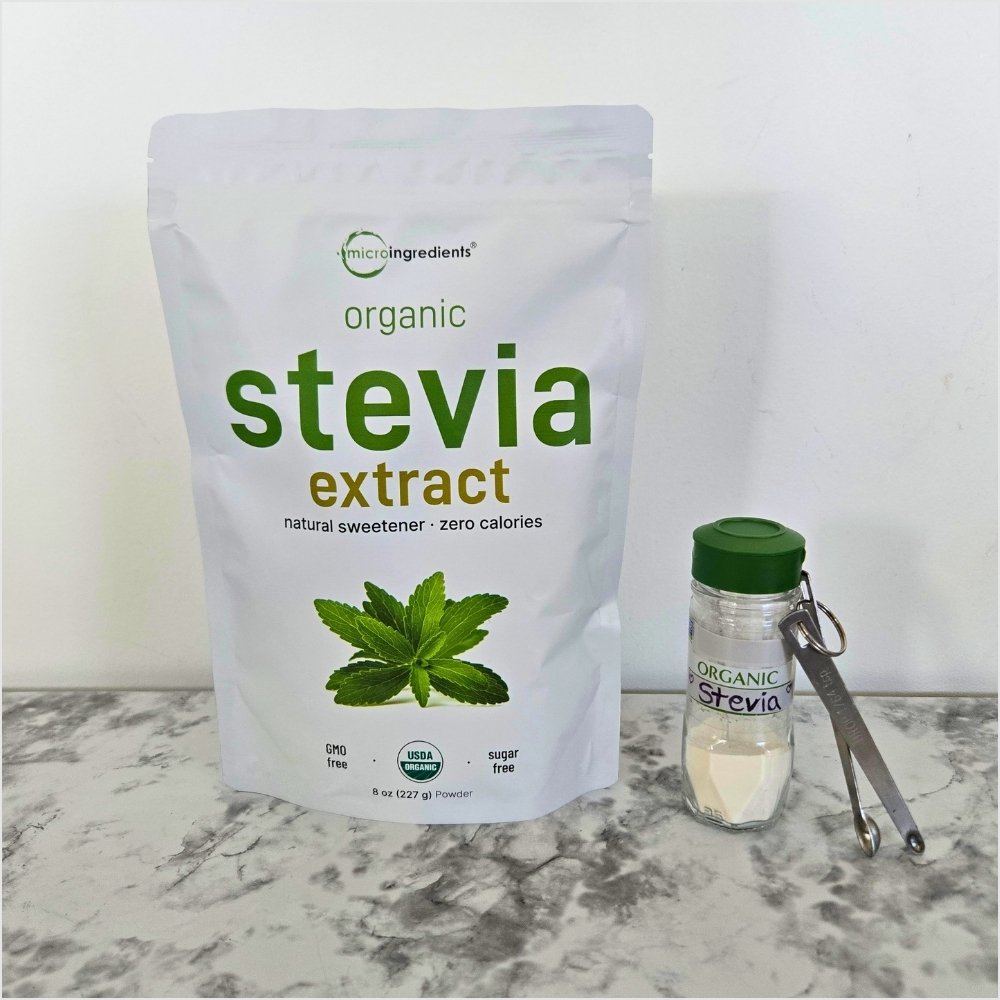
Read the label on yours. A lot of the stevia on the shelf is mostly filler, and some of it lists dextrose or maltodextrin first. Dextrose is sugar, and maltodextrin turns into sugar quickly in your body.
When I am out and about, a couple of regular stevia packets, fillers and all, are still a better choice for me than the artificial ones. And if I know there will be coffee, like at church, I bring my own organic unsweetened coconut milk with my stevia already stirred in.
You may be hearing about allulose on YouTube, and the early research is interesting. It is a rare sugar that tastes about 70% as sweet as regular sugar, with almost no calories, and in healthy people it barely raised blood sugar at all. But it takes spoonfuls, not a pinch like stevia, and most of what you eat is cleared by your kidneys. It has not been studied in people with cirrhosis yet. I am keeping an eye on it, and if you want to try it, ask your team first.
And what about honey? It has real good things in it. But when I tried it, I could feel it in my liver, so I looked into why. Honey is almost 40% fructose, the same fructose again, and a tablespoon has about 16 grams of sugar. On top of that, many of us with cirrhosis handle sugar less well, because a damaged liver has a harder time storing and managing it. So what my body was telling me was right. I leave honey out.
My answer to dessert
My favorite place for stevia is my dessert salad. In the evening, after my first salad and some of my soup, I have my kale salad with a little stevia and some unsweetened organic coconut milk. I am still getting everything that is in the kale, and it tastes like dessert.
Then I top off my evening with about 10 under ripe blueberries. It is a simple way to have a healthy bowel movement the next morning.
That is my answer to dessert. Cookies, cake and other high sugar desserts are hard on a liver like ours, and there is no need for them when something nourishing can taste like dessert too.
One more thing that goes against what you usually hear. A lot of advice says not to eat right before bed, but for those of us with cirrhosis, a bedtime snack can help, and liver specialists recommend one. If I think I am going to be hungry, I eat a tiny bit of pumpkin seeds or a little broccoli before I get in bed, so I do not wake up hungry in the middle of the night.
If your team has you on a special eating plan, like a bedtime snack or medicine for your blood sugar, follow it, and bring this post to them if you have questions.
Why I want you to know this
I was not careful with sugar in my early days because I did not know. Now you do.
The best thing I know to do is feed my gut microbiome and eat what GOD gave us, before all the processing.
And if there is something you can’t seem to put down on your own, I understand. I couldn’t put down the grapes on my own either. GOD took them away from me, and I know HE can do the same for you. HE’s done that with so many things in my life, and it is such a blessing, because it is HIS strength in us, and it’s not on our own strength.
So talk to HIM. Maybe you don’t know HIM yet. I didn’t either, not at the start, not in the amazing way I know HIM now. You can talk to JESUS the way you would talk to someone right there in the room with you, because HE is. HE hears every word, and HE knows your thoughts before you ever say them. Ask HIM for help every time you are struggling. It can be as simple as, JESUS, please help me.
“How sweet are your words to my taste, sweeter than honey to my mouth!”
— Psalm 119:103 (NIV)
May you be blessed with the knowing that HIS words are the sweetest thing we will ever taste, and may the Holy Spirit be your helper on this journey, in your health, your faith and your kitchen.
In JESUS’ Name, Amen.
Prayers, blessings and broccoli sprouts, 💛✝️🥦🤗
Emily
Know someone who needs this? Send it to them.