
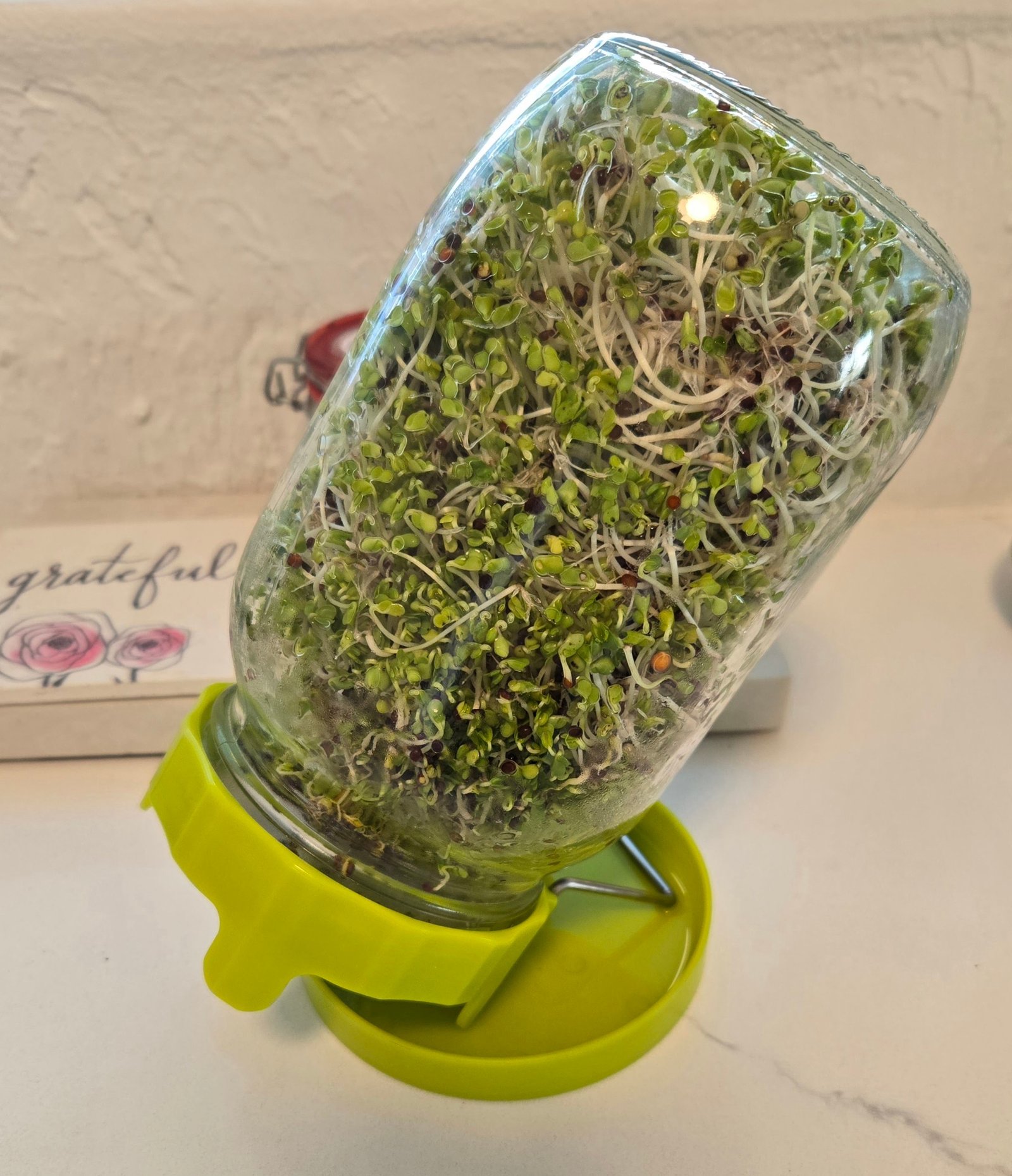
Six days ago this was two little scoops of tiny organic broccoli seeds, using the scoop that comes in the bag. That scoop is a tablespoon, so two tablespoons if you are working with your own. Today it is a jar full of flourishing, nourishing, organic broccoli sprouts, and all it asked of me was a rinse in the morning and a rinse at night.
Here is the actual math, because I did it. A 16 ounce bag of seeds runs about $22, and 1 ounce of seeds makes about 1 jar of sprouts, so that bag is around 16 jars. That works out to about $1.36 a jar. The first time you also buy the sprouting jar, about $14, which brings that first bag to about $2.25 a jar.
And a jar at home gives you about 4 times what comes in one of those plastic clamshells at the grocery store, which costs several dollars on its own. The freshness does not even compare.
I have been doing this for years and I still get excited every single time.
In my sicker days this was more than food. There is something about walking past a jar that is visibly growing before your eyes, something that is going to feed you in a few days, when the day itself has been long. It still means that to me now, and now it is also simply a rhythm I know my body is better for.
I start a new jar about every other week. Here is how I know when: once I am down to one regular size mason jar of sprouts left in the refrigerator, it is time for day one again. It depends how many you eat, but that one jar left is my signal.
Why broccoli sprouts, and what is actually happening
Stay with me here, because learning this is the part that really got me excited about these little powerhouse sprouts.
Broccoli seeds carry a compound called glucoraphanin. On its own it does nothing much. But the plant also carries an enzyme called myrosinase, and the two are kept apart until the plant is broken open. The moment they meet, glucoraphanin becomes sulforaphane.
- glucoraphanin — gloo-koh-RAF-uh-nin
- myrosinase — my-ROSS-in-ace
- sulforaphane — sul-FOR-uh-fane
I am giving you how to say them because once you can say a thing out loud, you can tell somebody else about it.
Which means the reaction starts in your mouth. When you crunch through a mouthful of sprouts you are rupturing those little cells with your own teeth and setting the whole thing off. So chew them well. That crunch is not just a nice texture, it is the beginning of the good part.
And here is what sulforaphane does once it is in you. It does not go around neutralizing things itself. It goes to your cells and switches on your own defenses. It releases something called Nrf2, which travels into the nucleus of the cell and turns on a whole set of genes, and those genes build your phase two enzymes. Those are your body’s cleanup crew. They take hold of harmful compounds, neutralize them, and send them out.
You are not eating a protective compound. You are eating the switch that turns your own protection on.
Read the science for yourself at the Linus Pauling Institute
And this is why the sprouts and not the head of broccoli. Broccoli sprouts have been measured at around 7 to 12 micromoles of glucoraphanin per gram through the days you would actually be eating them. A head of broccoli from the store comes in under 1.6, and often well under that.
That is roughly 5 to 10 times more, from something growing on your counter for a fraction of what the broccoli cost.
And if broccoli is hard for you to get through in any quantity, a small handful of sprouts is doing a great deal of work for you.
The broccoli tip while we are here, because I want everyone to know it
Heat destroys myrosinase. So if you cook your broccoli, the enzyme that makes sulforaphane is gone, and most of that good is lost. Your gut bacteria can make a little of it themselves, but the conversion drops to around 12%.
Here is the fix, and it takes two seconds. Sprinkle ground mustard powder on your cooked broccoli. Mustard seed carries that same enzyme, and adding it back has been shown to bring the sulforaphane up several times over.
And raw broccoli sprouts on top of cooked broccoli do the same job, because they are raw and their enzyme is still intact. That is why I pile them on.
Raw broccoli is worth a word too, because people ask. A raw head still has its enzyme, so it can make sulforaphane perfectly well. What it does not have is anything like the amount of glucoraphanin the sprouts carry. That is the whole difference. Raw broccoli has the tool and a little of the material. Cooked broccoli has the material and has lost the tool, which is what the mustard powder puts back. The sprouts arrive with both, and with far more to work with.
What I use
Organic heirloom broccoli seeds, and a wide mouth sprouting jar with a mesh lid that clips onto its own stand, plus a black neoprene sleeve. Mine are ZestiGreens seeds and I have used them for years.
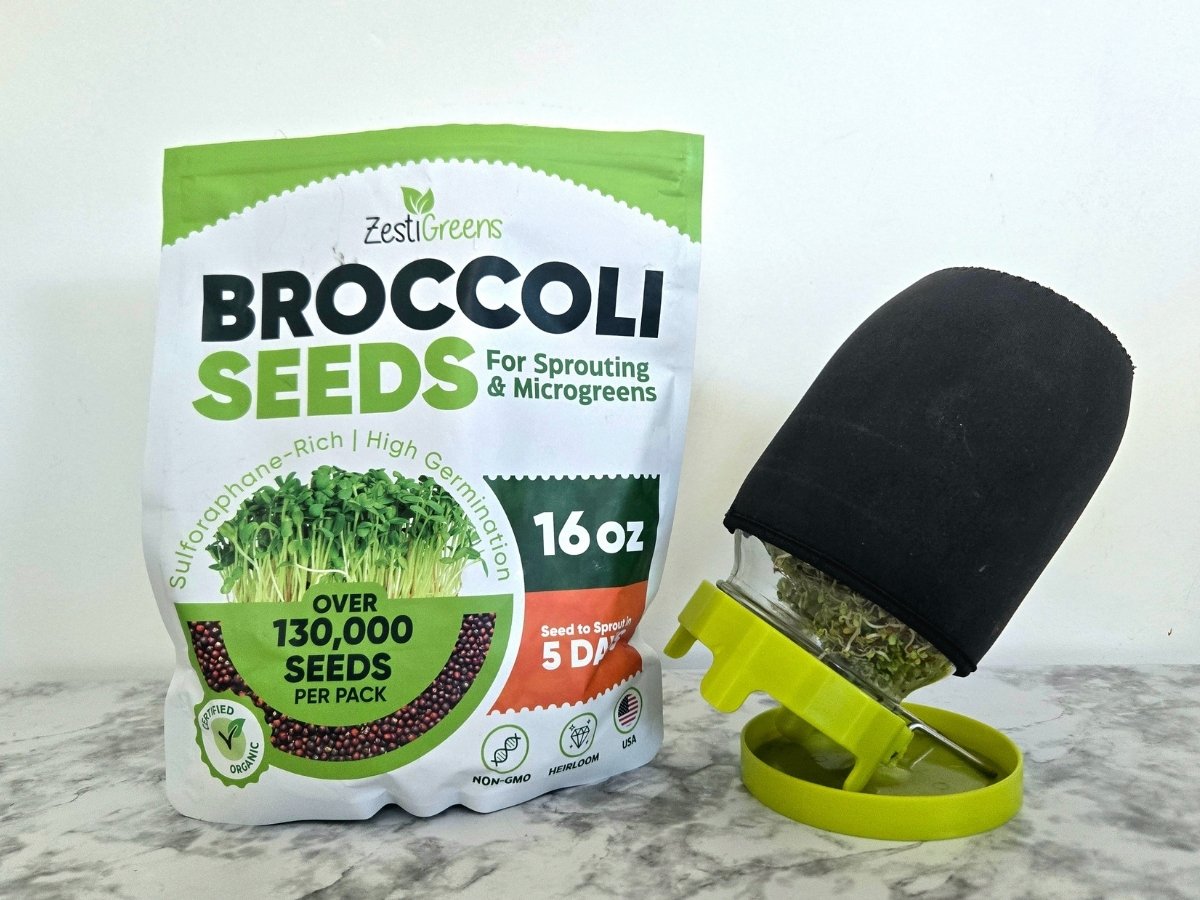
One thing before the how-to. Seed sourcing matters more than anything else you will read about sprouting, so buy from somewhere you trust and stay with it. I use certified organic heirloom seed and I have used the same supplier for years.
Day 1, in the evening
I start by cleaning the jar with boiling water. Just a little, swirled around, so I know it is properly clean. Keep the sleeve on while you do it. Then leave the empty jar on the counter to cool.
First you are rinsing the seeds. Water in, then the seeds, then top it off with more water. Put the mesh lid on, swirl, and pour the water out through the mesh. Do that 3 times. My seeds are good seeds and they do not need it, and I do it anyway.
Now you are soaking. Fill the jar about halfway with fresh water and leave it standing upright with the water in it. Set the plastic drain tray over the top like a lid so nothing settles in while it soaks. The packet says 8 to 12 hours, and the easiest way to do this is to start it before bed and wake up to soaked seeds.
Day 2, and every day after
In the morning, drain it. Rinse 3 times, tilting the jar as you go so the sides stay clean. Now it goes into the stand at an angle, upside down, sleeve on, just like the picture that comes with it. If you have the same jar as me, look at the photo above.
Do that triple rinse twice a day, and the easiest thing is to hang it on something you already do. Mine happens while the coffee is going in the morning, and again while I am making dinner. The jar is right there on the counter, so it is hard to forget.
The sleeve is there to keep them in the dark, because dark is where seeds want to germinate. It stays on for the first 4 or 5 days.
Around day 4, the step no instructions include
I have never seen this on any set of instructions, and it is the single most useful thing I have picked up.
Take the lid off and fill the jar with water almost to the rim. Stir it gently with a clean fork.
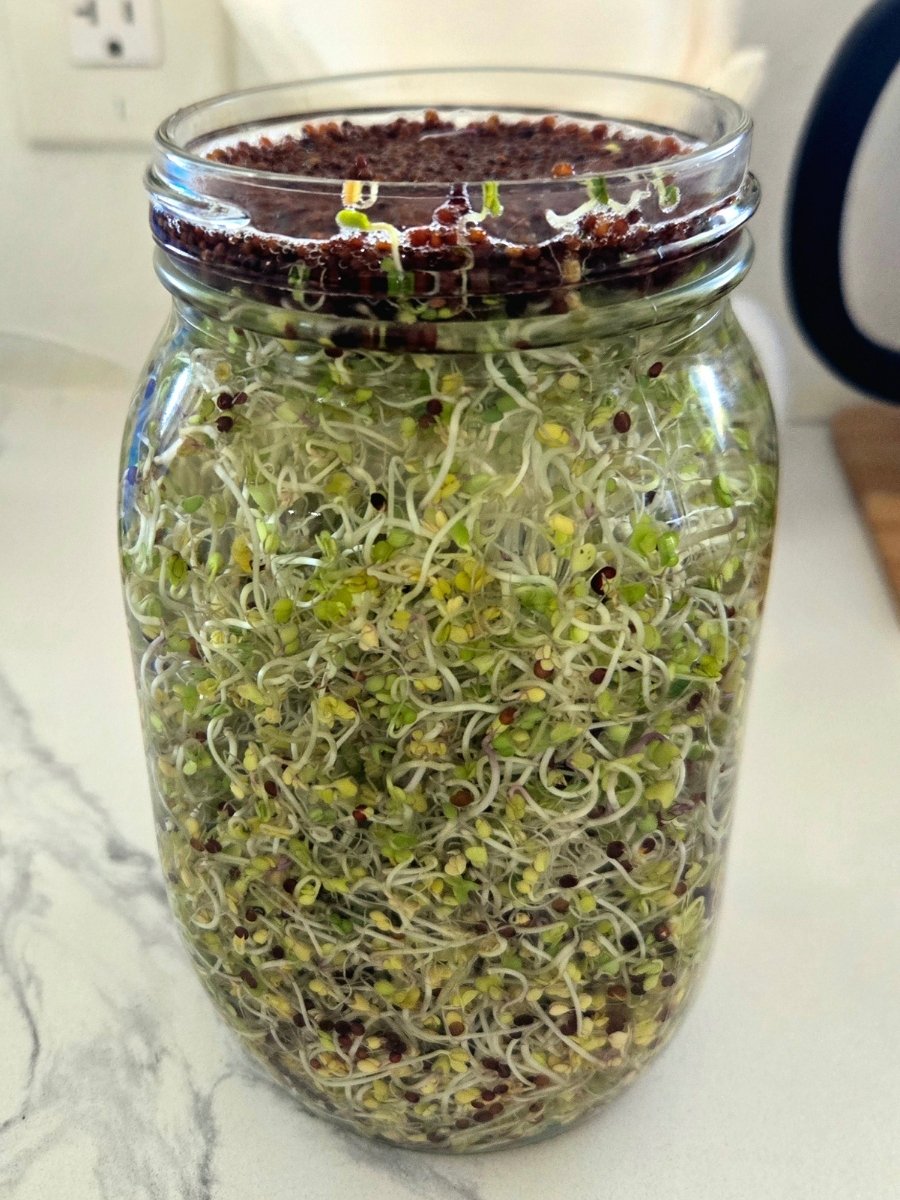
Most of those little seed hulls float straight to the top. Take a big spoon and skim them off into the sink. Put the lid back on and do your three rinses, and if there are still hulls sitting on the lid, take it off and shake them out.
That is it. No second dish to wash. I used to empty all the sprouts into a big glass dish, fill it with water and try to float the hulls off that way, and then I had a whole drying process on top of it. This way takes a minute, works beautifully, and the whole project stays contained in one little jar.
Two things you get out of it. The hulls are perfectly fine to eat, this is not a safety thing, it is about keeping your sprouts as fresh as possible for as long as possible, and taking most of the hulls out makes a noticeable difference. And the gentle stirring separates the sprouts a little so they do not grow into one tight tangle, which makes everything easier at the end.
Two things that will worry you, and should not
Somewhere around day 3 you will see fine white fuzz on the roots and be certain it is mold. It is not. Those are root hairs. I looked it up in a panic in my early days and I would like to save you that moment.
And if the lid ever looks like it needs washing, wash it. Go easy on the soap. You do not want soap in your sprouts.
Around day 5, finishing them
Take the black sleeve off and let them have daylight. They green right up, and that is chlorophyll doing its work. Give them a day of that, or a little longer if you like.
Keep rinsing as normal. Then, before they go in the refrigerator, let them dry. Do not put soaking wet sprouts into a sealed container. The simple way is to do a rinse and then just let them keep draining in the stand until the next rinse would have been due. If mine still feel damp when I lift them out, I put them on a plate and pat them with a paper towel first.
I store mine in the refrigerator, in regular size mason jars, with a paper towel on the bottom and another on top.
Sprouts do not like going hot and cold and hot again. Take out what you need and put the jar straight back in the fridge.
How I eat them
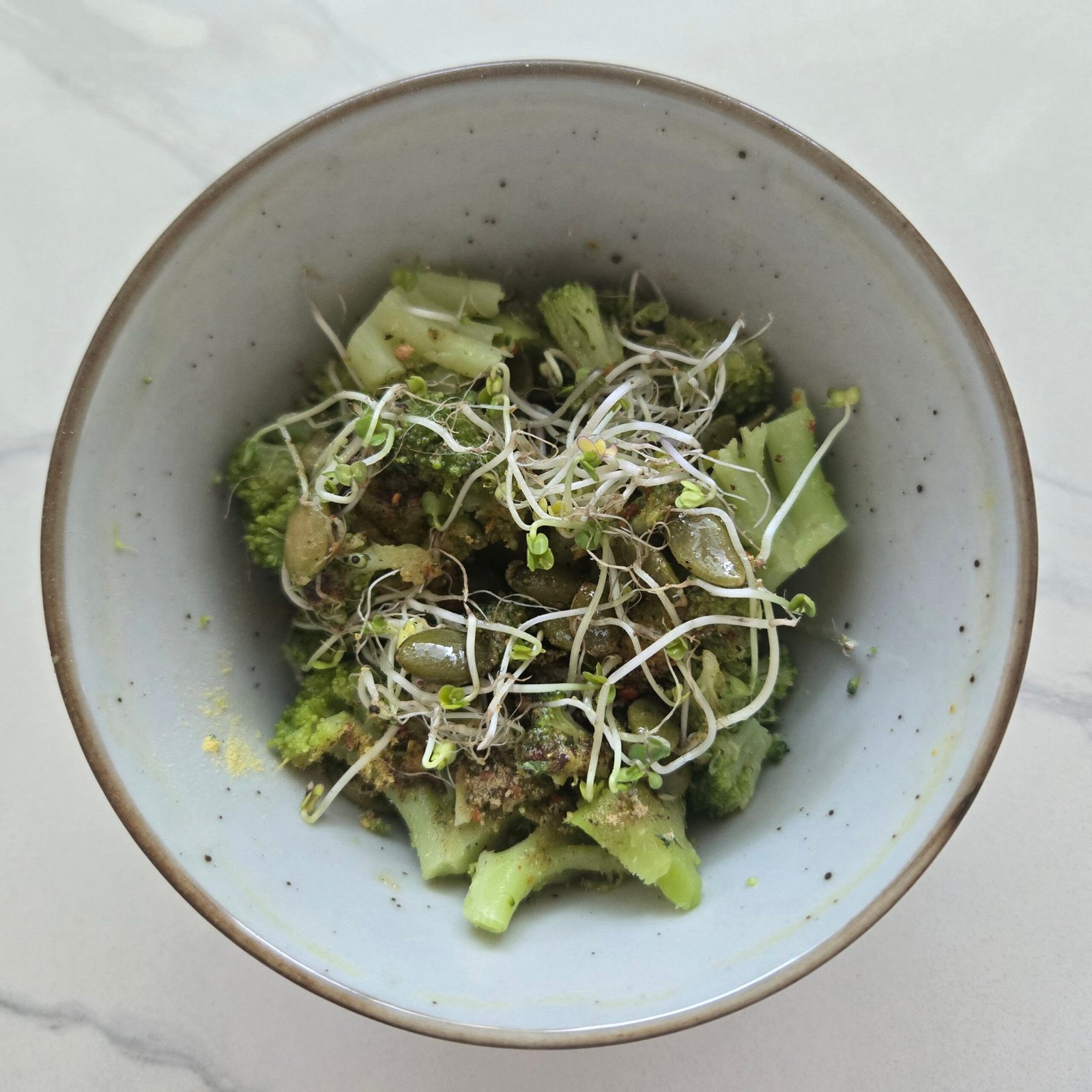
In my Embrobi Egg Smash every morning. In salad dressings. And when I want an afternoon boost, my go-to is cooked broccoli with raw broccoli sprouts piled on top, ground mustard powder, organic extra virgin olive oil, a little apple cider vinegar, Benson’s Table Tasty, raw organic pumpkin seeds, and nutritional yeast for the B vitamins.
One tip if you like a smoothie. Stir the sprouts in after it is blended rather than putting them through the blades. You want your own teeth doing that work, for the reason further up.
I have a little sticky note on my refrigerator that I wrote a long time ago. It says: when having doubts, eat broccoli sprouts. And pray.
Why I want you to try it
In 5 to 7 days from 2 tablespoons of seed to a jar full of food, on your counter, for a dollar and change. It is fun. It is easy. And it is so much better than anything you can buy.
I think every family should do this. I think every kid should grow up watching it happen. This is not only for those of us with liver issues. Every one of us has a liver worth looking after, and the science underneath this is real.
And on a hard day there is something in watching a tiny seed turn into food right on your kitchen counter. Getting to watch HIS creation do exactly what HE built it to do, close enough to touch, has never once gotten old for me.
“Night and day, whether he sleeps or gets up, the seed sprouts and grows, though he does not know how.”
— Mark 4:27 (NIV)
May you be blessed with the knowing that the One who turns a seed into food is at work in your life too, and I am so thankful HE brought you here.
Prayers, blessings and broccoli sprouts, 💛✝️🥦🤗
Emily
Know someone who needs this? Send it to them.