October is Liver Awareness Month. And I have to smile a little at that, because those of us living with cirrhosis are already very aware of our livers. Much more aware than the average person.
So this month, I want to share what I’d want everyone to know. What the liver does for us every day. What to feed it. And how to make its job a little easier.
It comes down to this. Give our liver and our body what they need, and give our liver fewer challenges, so it can thrive.
Give your liver what it needs, and fewer challenges, so it can thrive.
What your liver does, day and night
Your liver is working for you right now. It makes bile, which helps you break down fats. It makes the proteins that help your blood clot. It stores fuel for later and hands it back when you need energy. It clears medicines and other harmful things out of your blood. More than 500 vital jobs have been connected to the liver.
It also takes ammonia, which is poisonous to us, and turns it into urea, a waste your kidneys send out in your urine. When a liver can’t keep up with that job, ammonia builds up and can cloud your thinking. That’s called hepatic encephalopathy, and it’s what lactulose helps with.
- ammonia — uh-MOHN-yuh
- urea — yoo-REE-uh
- hepatic encephalopathy — hih-PAT-ik en-sef-uh-LOP-uh-thee
- lactulose — LAK-tyoo-lohs
And it keeps working at night. While you sleep, your liver hands back the fuel it stored during the day. A scarred liver can’t store as much, so a long night without food is harder on a liver like ours. That’s why liver specialists recommend a small bedtime snack. Mine is a tiny bit of pumpkin seeds or broccoli. I wrote about it in what sugar does to a liver like ours.
For those of us with cirrhosis, the liver is scarred, and it’s already working so hard. That’s why what we put on our plates matters so much.
Give it the food GOD made
I want to feed my body the food that is simply designed for us to eat. The food GOD created, not heavily processed and changed into a form that isn’t easily recognizable to our livers and bodies. That’s so hard for a liver to process, and ours is already working hard enough.
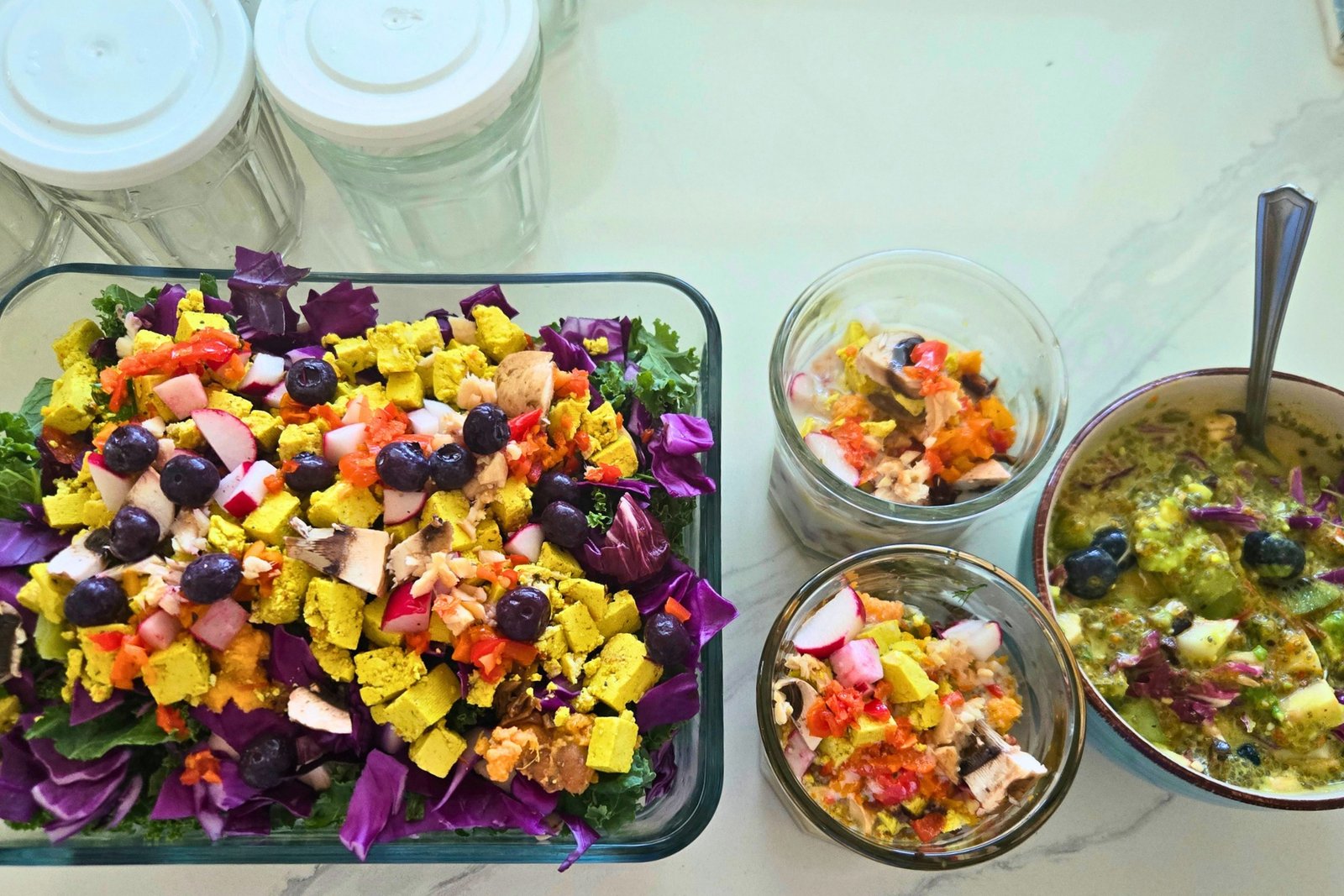
The photo at the top is real life, before I added the spices and before stirring, so you can see what goes in. That big dish is 2 days of my Embrobi salad. It fills 6 jars. I eat 2 at night, and the third is spread over the next day’s breakfast and lunch.
The salad is kale, red cabbage and radicchio, with radishes, mushrooms, blueberries, sweet potatoes, and my pickled ginger, pickled habaneros, pickled banana blossoms and pickled tricolor peppers on top, plus organic hemp seeds. Usually I add another green too, like mustard greens or bok choy. I just didn’t have any that day. When you go to the store, pick one interesting green as an extra, and add whatever else you love. Eat the rainbow! Every color is something different for your body to work with, and it makes a meal so much more fun to look at.
The yellow cubes are organic tofu. The color is turmeric. I also season it with garlic powder, onion powder, paprika, cayenne and nutritional yeast, sometimes a little sumac, my pickled tricolor peppers and pickled habaneros, a splash of bone broth, and Benson’s Table Tasty, of course. Tofu made with calcium sulfate also brings calcium, which matters to me because I can’t drink milk. Sometimes I add a meat protein as well, but not always.
My dressing is where everything comes together. I plump chia seeds in organic unsweetened coconut milk, then add raw organic pumpkin seeds, raw organic sunflower seeds and organic hemp seeds. Then the spices: Benson’s, organic ground mustard (both black and yellow), sumac, nutritional yeast, turmeric, ground black pepper, onion powder, garlic powder, cayenne and paprika. Then avocado, organic blueberries, a few cacao nibs, my pickled habaneros, banana blossoms, tricolor peppers and ginger, a little of whatever vegetables are going into the salad, and broccoli sprouts stirred right in. The seeds bring minerals like magnesium and zinc.
When I fill my salad jars, I do it like a parfait. Salad about halfway, a layer of dressing, more salad, then dressing on top. That way you get a really good consistency all the way through. If you’re cooking for your family, you don’t have to put it in jars at all.
The two cups beside the salad dish are my nightly soup cups, 2 servings from my mother batch. Each night I spoon some soup into a cup, then add fresh and pickled ingredients and my protein. The sweet potatoes make it nice and thick, like a stew. If it needs it, a little extra bone broth and some organic unsweetened coconut milk, and after I heat it, nutritional yeast, organic hemp seeds and organic extra virgin olive oil. I eat about half at night, and the rest goes on my Embrobi Egg Mash in the morning with some leftover salad. I do it this way so I don’t have to spend a lot of time.
A few things I add into every day: organic blueberries, cooled cooked sweet potatoes, avocado and organic extra virgin olive oil. I look for organic when possible.
This food is good for your whole family, too. It’s delicious, and it’s good for their livers as well.
Feed your body the food GOD made, in a form your liver recognizes.
Grow your good army
We need a good army inside of us. That army is your gut microbiome, the trillions of tiny living things in your gut that work for you.
- microbiome — my-kroh-BY-ohm
Here is why it matters for a liver like ours. The blood vessels from your gut travel straight to your liver. Almost everything you absorb from your food passes through your liver before it goes anywhere else. So what happens in your gut doesn’t stay in your gut. A well-fed army helps your whole body, and your liver is right there next in line.
There are two parts to growing your army: feed the army you have, and bring new recruits in.
Feeding it is about variety. Different microbes like different foods, mostly the fiber in plants, the part your own body can’t break down. In one large study, people who ate more than 30 different kinds of plants a week had more varied gut bacteria than people who ate 10 or fewer. That counts vegetables, fruits, seeds, beans, herbs and spices. Look at that salad again, and you can see how the numbers add up fast. Cruciferous vegetables like kale, cabbage and broccoli are some of my favorites, and broccoli sprouts are on my plate every day.
Those sprouts are how I put the army to work. They carry the makings of sulforaphane, which switches on your body’s own cleanup crew. If you cook your broccoli, sprinkle some ground mustard powder on it, and you put back the enzyme that cooking takes away. I explain all of that in how I grow broccoli sprouts in a jar.
- sulforaphane — sul-FOR-uh-fane
In the early days of my diagnosis, I toughed it out with at least a bag of cooked frozen broccoli, bloating and all. Now I know that growing the army first can make that a lot easier, and I want that for you.
Bringing new recruits in is where kefir comes in. I’m lactose intolerant, and I still have kefir every night, alongside a dairy pill, because the benefits are extraordinary. The fermentation does a lot of the work that we would otherwise have to do with other dairy. In one study of adults who have trouble with lactose, drinking kefir cut gas by more than half compared to milk. If you’re lactose intolerant too, it’s worth a shot.
- kefir — keh-FEER
Feed the army you have, and bring new recruits in.
Protein holds us together
In the beginning, I was told not to have much protein. Now I eat enough of it, and I can see it helping me build muscle, which I very much need. The advice has changed, too. Liver specialists now say protein should not be cut back for people with cirrhosis.
It’s good to have muscle to hold us together. And GOD holds everything together.
“HE is before all things, and in HIM all things hold together.”
— Colossians 1:17 (NIV)
Ask your team how much protein is right for you.
Low sodium is the door
Low sodium is where this started for me. My doctor set my sodium very low. When I was really sick, keeping the salt out made it all feel like less of a struggle. My ascites was less, and I could breathe so much better.
Even today, while thriving with cirrhosis, I still stick to low sodium. If I stack up foods with more natural sodium in a day, I can tell the difference. It just feels better on my body having less.
Your number belongs to you and your team. Ask them about it, and if they say lower, try it, and notice how your fluid, your breathing and how you feel change. There are plenty of minerals in food like this, so going lower on salt doesn’t mean going without.
Fewer challenges for your liver
Giving your liver what it needs is half of it. The other half is giving it fewer things to fight.
Alcohol. To a liver like mine, that is what it was. Poison. I wrote about that on what had to go.
Sugar. A liver turns extra sugar into fat. I wrote all about it in what sugar does to a liver like ours.
Heavily processed food. The packaged things that were never really food to begin with.
And some medicines. You know the fine print at the end of a commercial, read fast in a different voice? “May cause liver damage.” It really can. Medicines have side effects, and some are hard on a liver like ours. Even an over-the-counter pain reliever is a question for your team. When I hurt, I reach for heat, ice, my TENS unit, prayer, rest and staying hydrated, and I keep on moving.
I learned about combinations the hard way. I was taking spironolactone, a water pill that holds on to potassium, and I was using a salt substitute made of potassium chloride. Together, they pushed my potassium too high. If you take spironolactone, turn every salt substitute around and make sure it does not have potassium chloride.
- spironolactone — speer-oh-no-LAK-tone
Take your whole list to your team, including anything over the counter and every supplement. That’s a question for them, not something to stop on your own.
And the best doctor is JESUS. HIS healing is medicine with no side effects, only good ones.
Where to start
You don’t have to do all of this at once. I’d start with the three steps I’d shout from the mountaintops: swap the salt, grow your own broccoli sprouts, and eat cruciferous vegetables every day.
And this month, share what you know. We’re already the most liver‑aware people around. Tell the people you love what their liver does for them, and how to be good to it.
“Then GOD said, ‘I give you every seed-bearing plant on the face of the whole earth and every tree that has fruit with seed in it. They will be yours for food.’”
— Genesis 1:29 (NIV)
May your plate be full of color this week and your heart full of JESUS-Joy Sparkles. I am so thankful HE brought you here.
In JESUS’ Name, Amen.
Prayers, blessings and broccoli sprouts, 💛✝️🥦🤗
Emily
Know someone who needs this? Send it to them.