Category: Blog

Your blog category

  • We’re already the most liver‑aware people I know

    We’re already the most liver‑aware people I know

    October is Liver Awareness Month. And I have to smile a little at that, because those of us living with cirrhosis are already very aware of our livers. Much more aware than the average person.

    So this month, I want to share what I’d want everyone to know. What the liver does for us every day. What to feed it. And how to make its job a little easier.

    It comes down to this. Give our liver and our body what they need, and give our liver fewer challenges, so it can thrive.

    Give your liver what it needs, and fewer challenges, so it can thrive.

    What your liver does, day and night

    Your liver is working for you right now. It makes bile, which helps you break down fats. It makes the proteins that help your blood clot. It stores fuel for later and hands it back when you need energy. It clears medicines and other harmful things out of your blood. More than 500 vital jobs have been connected to the liver.

    It also takes ammonia, which is poisonous to us, and turns it into urea, a waste your kidneys send out in your urine. When a liver can’t keep up with that job, ammonia builds up and can cloud your thinking. That’s called hepatic encephalopathy, and it’s what lactulose helps with.

    • ammonia — uh-MOHN-yuh
    • urea — yoo-REE-uh
    • hepatic encephalopathy — hih-PAT-ik en-sef-uh-LOP-uh-thee
    • lactulose — LAK-tyoo-lohs

    For those of us with cirrhosis, the liver is scarred, and it’s already working so hard. That’s why what we put on our plates matters so much.

    Give it the food GOD made

    I want to feed my body the food that is simply designed for us to eat. The food GOD created, not heavily processed and changed into a form that isn’t easily recognizable to our livers and bodies. That’s so hard for a liver to process, and ours is already working hard enough.

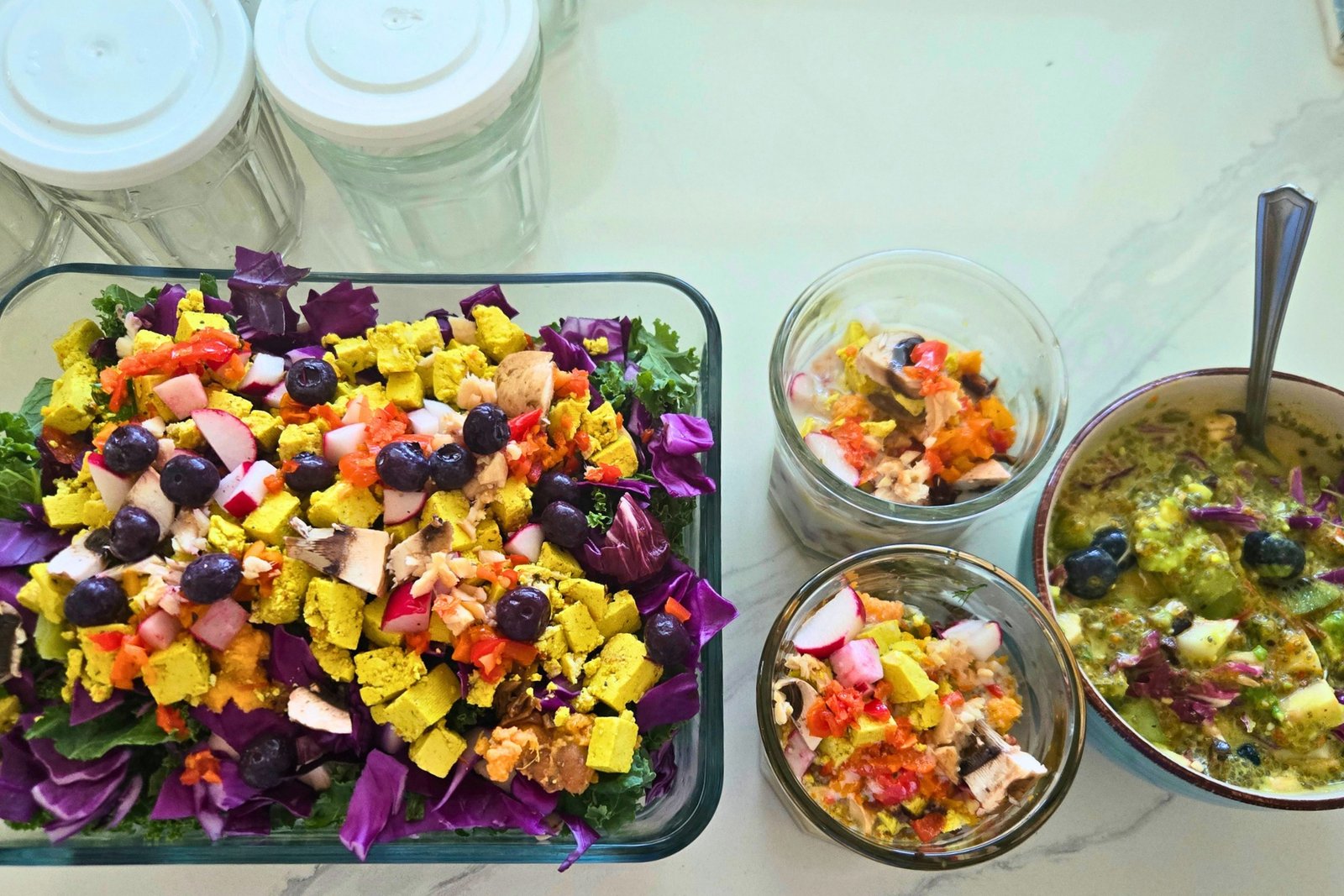
    The photo at the top is real life, before I added the spices and before stirring, so you can see what goes in. That big dish is 2 days of my Embrobi salad. It fills 6 jars. I eat 2 at night, and the third is spread over the next day’s breakfast and lunch.

    The salad is kale, red cabbage and radicchio, with radishes, mushrooms, blueberries, sweet potatoes, and my pickled ginger, pickled habaneros, pickled banana blossoms and pickled tricolor peppers on top, plus organic hemp seeds. Usually I add another green too, like mustard greens or bok choy. I just didn’t have any that day. When you go to the store, pick one interesting green as an extra, and add whatever else you love. Eat the rainbow! Every color is something different for your body to work with, and it makes a meal so much more fun to look at.

    The yellow cubes are organic tofu. The color is turmeric. I also season it with garlic powder, onion powder, paprika, cayenne and nutritional yeast, sometimes a little sumac, my pickled tricolor peppers and pickled habaneros, a splash of bone broth, and Benson’s Table Tasty, of course. Tofu made with calcium sulfate also brings calcium, which matters to me because I can’t drink milk. Sometimes I add a meat protein as well, but not always.

    My dressing is where everything comes together. I plump chia seeds in organic unsweetened coconut milk, then add raw organic pumpkin seeds, raw organic sunflower seeds and organic hemp seeds. Then the spices: Benson’s, organic ground mustard (both black and yellow), sumac, nutritional yeast, turmeric, ground black pepper, onion powder, garlic powder, cayenne and paprika. Then avocado, organic blueberries, a few cacao nibs, my pickled habaneros, banana blossoms, tricolor peppers and ginger, a little of whatever vegetables are going into the salad, and broccoli sprouts stirred right in. The seeds bring minerals like magnesium and zinc.

    When I fill my salad jars, I do it like a parfait. Salad about halfway, a layer of dressing, more salad, then dressing on top. That way you get a really good consistency all the way through. If you’re cooking for your family, you don’t have to put it in jars at all.

    The two cups beside the salad dish are my nightly soup cups, 2 servings from my mother batch. Each night I spoon some soup into a cup, then add fresh and pickled ingredients and my protein. The sweet potatoes make it nice and thick, like a stew. If it needs it, a little extra bone broth and some organic unsweetened coconut milk, and after I heat it, nutritional yeast, organic hemp seeds and organic extra virgin olive oil. I eat about half at night, and the rest goes on my Embrobi Egg Mash in the morning with some leftover salad. I do it this way so I don’t have to spend a lot of time.

    A few things I add into every day: organic blueberries, cooled cooked sweet potatoes, avocado and organic extra virgin olive oil. I look for organic when possible.

    This food is good for your whole family, too. It’s delicious, and it’s good for their livers as well.

    Feed your body the food GOD made, in a form your liver recognizes.

    Grow your good army

    We need a good army inside of us. That army is your gut microbiome, the trillions of tiny living things in your gut that work for you.

    • microbiome — my-kroh-BY-ohm

    Here is why it matters for a liver like ours. The blood vessels from your gut travel straight to your liver. Almost everything you absorb from your food passes through your liver before it goes anywhere else. So what happens in your gut doesn’t stay in your gut. A well-fed army helps your whole body, and your liver is right there next in line.

    There are two parts to growing your army: feed the army you have, and bring new recruits in.

    Feeding it is about variety. Different microbes like different foods, mostly the fiber in plants, the part your own body can’t break down. In one large study, people who ate more than 30 different kinds of plants a week had more varied gut bacteria than people who ate 10 or fewer. That counts vegetables, fruits, seeds, beans, herbs and spices. Look at that salad again, and you can see how the numbers add up fast. Cruciferous vegetables like kale, cabbage and broccoli are some of my favorites, and broccoli sprouts are on my plate every day.

    • sulforaphane — sul-FOR-uh-fane

    In the early days of my diagnosis, I toughed it out with at least a bag of cooked frozen broccoli, bloating and all. Now I know that growing the army first can make that a lot easier, and I want that for you.

    Bringing new recruits in is where kefir comes in. I’m lactose intolerant, and I still have kefir every night, alongside a dairy pill, because the benefits are extraordinary. The fermentation does a lot of the work that we would otherwise have to do with other dairy. In one study of adults who have trouble with lactose, drinking kefir cut gas by more than half compared to milk. If you’re lactose intolerant too, it’s worth a shot.

    • kefir — keh-FEER

    Feed the army you have, and bring new recruits in.

    Protein holds us together

    In the beginning, I was told not to have much protein. Now I eat enough of it, and I can see it helping me build muscle, which I very much need. The advice has changed, too. Liver specialists now say protein should not be cut back for people with cirrhosis.

    It’s good to have muscle to hold us together. And GOD holds everything together.

    “HE is before all things, and in HIM all things hold together.”

    — Colossians 1:17 (NIV)

    Ask your team how much protein is right for you.

    Low sodium is the door

    Low sodium is where this started for me. My doctor set my sodium very low. When I was really sick, keeping the salt out made it all feel like less of a struggle. My ascites was less, and I could breathe so much better.

    Even today, while thriving with cirrhosis, I still stick to low sodium. If I stack up foods with more natural sodium in a day, I can tell the difference. It just feels better on my body having less.

    Your number belongs to you and your team. Ask them about it, and if they say lower, try it, and notice how your fluid, your breathing and how you feel change. There are plenty of minerals in food like this, so going lower on salt doesn’t mean going without.

    Fewer challenges for your liver

    Giving your liver what it needs is half of it. The other half is giving it fewer things to fight.

    Heavily processed food. The packaged things that were never really food to begin with.

    And some medicines. You know the fine print at the end of a commercial, read fast in a different voice? “May cause liver damage.” It really can. Medicines have side effects, and some are hard on a liver like ours. Even an over-the-counter pain reliever is a question for your team. When I hurt, I reach for heat, ice, my TENS unit, prayer, rest and staying hydrated, and I keep on moving.

    I learned about combinations the hard way. I was taking spironolactone, a water pill that holds on to potassium, and I was using a salt substitute made of potassium chloride. Together, they pushed my potassium too high. If you take spironolactone, turn every salt substitute around and make sure it does not have potassium chloride.

    • spironolactone — speer-oh-no-LAK-tone

    Take your whole list to your team, including anything over the counter and every supplement. That’s a question for them, not something to stop on your own.

    And the best doctor is JESUS. HIS healing is medicine with no side effects, only good ones.

    Where to start

    You don’t have to do all of this at once. I’d start with the three steps I’d shout from the mountaintops: swap the salt, grow your own broccoli sprouts, and eat cruciferous vegetables every day.

    And this month, share what you know. We’re already the most liver‑aware people around. Tell the people you love what their liver does for them, and how to be good to it.

    “Then GOD said, ‘I give you every seed-bearing plant on the face of the whole earth and every tree that has fruit with seed in it. They will be yours for food.’”

    — Genesis 1:29 (NIV)

    May your plate be full of color this week and your heart full of JESUS-Joy Sparkles. I am so thankful HE brought you here.

    In JESUS’ Name, Amen.

    Prayers, blessings and broccoli sprouts, 💛✝️🥦🤗
    Emily

    Know someone who needs this? Send it to them.
  • What sugar does to a liver like ours

    What sugar does to a liver like ours

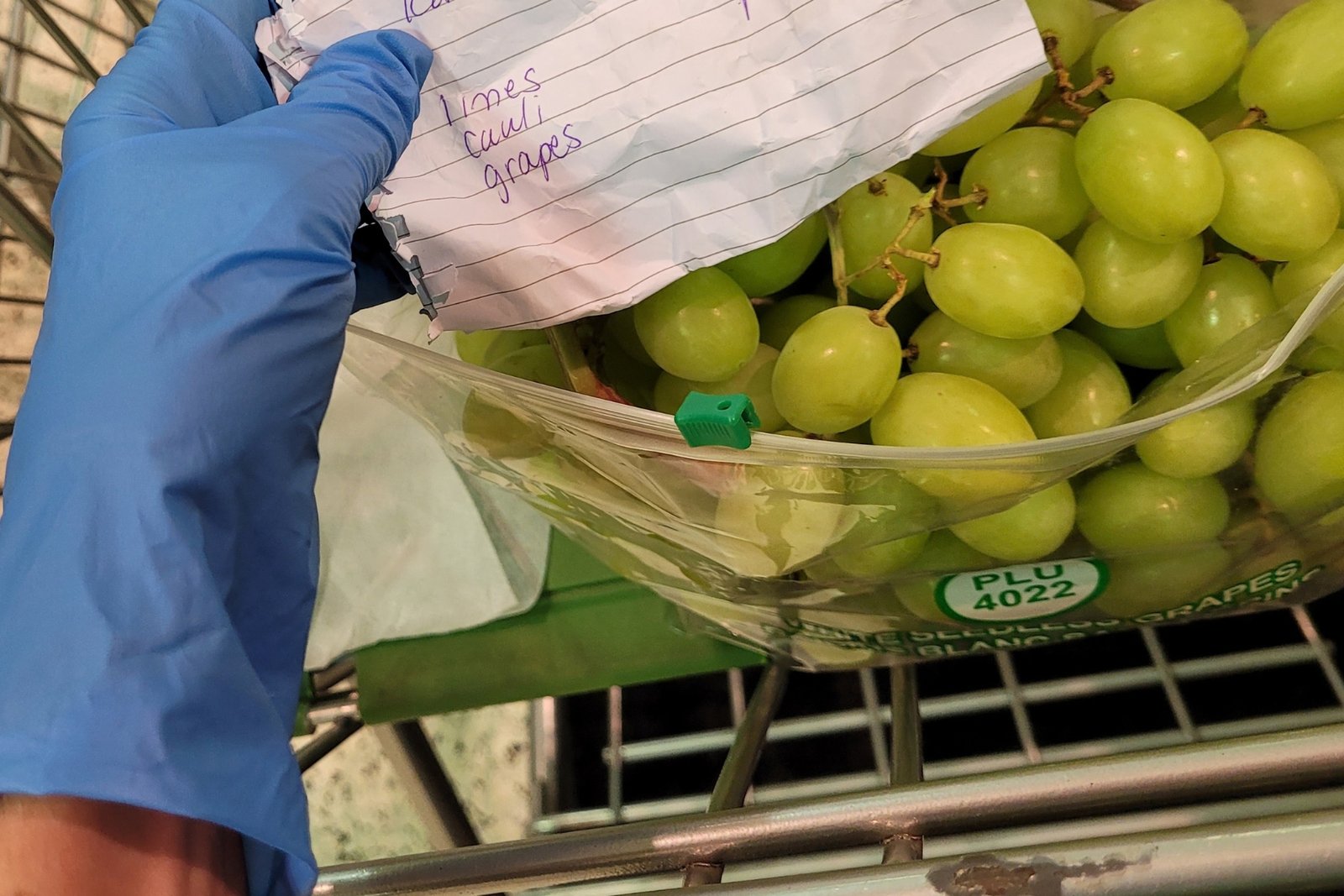
    For about 2 and a half years, in my early days with end-stage liver disease, I was buying bags and bags of green grapes and eating them. Pounds of them. I did not know that sugar was bad for a liver like mine.

    That is my hand in the photo at the top, during the pandemic. You can tell by the blue gloves. Face masks and gloves, we all remember those days. Those were conventional grapes, too. My shopping has changed a lot since then.

    Looking back, I think part of it was that I reached for sugar after I stopped drinking. A lot of people do when they quit alcohol.

    Then I saw a YouTube video that explained how sugary grapes are. I do not know exactly how I quit after that. That was GOD taking it away from me. I do not need grapes anymore. I only thought I did.

    Here is what I learned about why it mattered, because the why is worth your time.

    Why sugar lands on the liver

    Sugar is not one thing. Table sugar is about half glucose and half fructose, and our bodies handle those two halves very differently.

    Glucose is fuel that almost every cell you have can use. Fructose is different. Your gut can handle a small amount of it, and past that, it goes to your liver.

    • glucose — GLOO-kohs
    • fructose — FROOK-tohs

    Stay with me here, because this is the part that matters most.

    When your body breaks down glucose, there is a step in the middle where it can slow the line down if it does not need any more right now. Fructose goes in past that step. There is no point along the way where the liver can slow it down.

    So the liver does what it can with the fructose that keeps arriving, and it turns some of that sugar into fat, right there inside the liver. That has a name, de novo lipogenesis, which means the liver making brand new fat out of sugar.

    • de novo lipogenesis — dee NOH-voh lye-puh-JEN-uh-sis

    In people who already have a fatty liver, more than a quarter of the fat in it was made this way, by the liver itself, not eaten as fat.

    And there is a second problem. While the liver is busy turning sugar into fat, it burns less of the fat it already has. So the fat builds up from both sides, more being made and less being burned, for as long as the sugar keeps coming. For those of us with cirrhosis, our livers are already scarred and working hard. Fat building up inside is not something a liver like ours needs.

    Some of the fat in a fatty liver was never eaten. The liver made it out of sugar.

    Fatty liver, with or without alcohol

    Even though I had quit alcohol, with all those grapes I was still feeding my liver something terrible. A fatty liver does not only come from alcohol. One of the most common liver diseases in the world has nothing to do with drinking, and in this country, cirrhosis from it is now as common a reason for a liver transplant as alcohol. It is tied to how so many of us live and eat now: extra weight, especially around the middle, blood sugar running high, high blood fats, and a lot of sugar, especially fructose. So sugar is part of the story, not all of it. That liver disease used to be called non-alcoholic fatty liver disease. In June 2023 the liver societies renamed it metabolic dysfunction-associated steatotic liver disease, or MASLD, and its more advanced form metabolic dysfunction-associated steatohepatitis, or MASH. The old names described people by what they were not. If you ever see steatotic on a report or hear it from your team, it simply means fatty. And steatohepatitis means a fatty liver that has also become inflamed. Over time, that inflammation can scar the liver, and when the scarring is bad enough, it becomes cirrhosis. That is why this matters to us.

    • steatotic — stee-uh-TOT-ik
    • steatohepatitis — stee-uh-toh-hep-uh-TY-tis

    You may have heard that sugar is just as bad as alcohol for your liver. I thought that too for a while. I had a fatty liver myself, and mine came from alcohol. Your liver is the organ that does most of the work of breaking down both sugar and alcohol. Alcohol gets there by a different road, but it also pushes the liver to make more fat and burn less. Still, they are not the same thing, and the research does not go as far as calling them equal.

    What one study found in people with cirrhosis

    Eighty people with cirrhosis, all of them waiting for a liver transplant, wrote down everything they ate for 3 days. Over the next 6 months, about a third of them saw their MELD score improve, and that group had been eating noticeably less simple sugar than the people whose scores stayed the same or got worse.

    MELD is the score transplant teams use to measure how sick a liver is. Lower is better.

    I want to be careful with that. Eighty people is not many. Nobody changed anyone’s diet. The researchers wrote down what people were already eating and watched what happened, so it shows a link, not proof.

    And when I was diagnosed in 2018, I had prediabetes. Today I do not even have that. I know the changes I was led to make are a big part of why.

    Why would we keep feeding our livers something we already know is hard on them? When I eat what GOD made, I feel better. I want that for you too.

    What you put on your plate absolutely counts, even with cirrhosis.

    How I choose my fruit

    My rule for fruit is simple. Under ripe.

    I choose fruits that are high in benefits, like fiber and antioxidants, and low in sugar.

    The under ripe part started as a question I kept asking myself. If a fruit does not taste as sweet, does it have less sugar? So I dug into the research, and for the same fruit, it held up. The riper it gets, the sweeter it gets, so under ripe means less sugar.

    The one fruit I let ripen all the way is avocado. It has almost no sugar to begin with, and it is full of good fats and fiber. I eat about one avocado a day, spread out between my breakfast and my salad dressing at dinner. Avocados are high in potassium, though, so if your team has you watching yours, ask them how much fits for you.

    Tart blueberries are my favorite fruit. Look for the lighter purple ones.

    I eat half a kiwi a day, with the skin.

    Bananas I only eat once in a while, and only half of one. When I do, I pick them on the green side, because an under ripe banana has more resistant starch, a kind of starch that feeds your gut instead of turning into sugar.

    I also keep my fruit to small amounts. I get many of my nutrients from vegetables and from a wide variety of what GOD has given us to eat. Fruit is a small part of my plate, not the main part.

    And go easy on the sweetest ones, like grapes, mangoes, cherries, figs and lychees. Grapes are the one that caught me. They are high in sugar and low in fiber.

    Apples and pears are worth knowing about too. They are not the sweetest, but more than half of their sugar is fructose, the same fructose this whole post is about. I can feel the effect of both, so I stay away from them.

    Berries are a better choice. Besides my blueberries, raspberries and blackberries are great ones. They have about a third of the sugar of grapes, and lots of fiber. And lemons and limes add flavor with almost no sugar at all.

    Diet soda is not the answer either

    Please do not read this and switch to diet soda. The best switch is no soda at all. Water and unsweetened tea are great choices. A lot of bottled tea is loaded with sugar, so check the label. If you like your tea sweet, a little stevia works, and I will tell you more about that later in this post.

    Regular soda is sugar you drink, and in this country most of it is sweetened with high fructose corn syrup, which is full of the fructose that is so hard on our livers. But the diet version is not the fix.

    I am very wary of artificial sweeteners. I do not buy them, and I do not use them: aspartame, sucralose, which is the sweetener in Splenda, and saccharin. All three are made in a lab, not grown.

    I went through a stretch early on of buying sugar free candies, and that was a mistake. Take the sugar out and something has to replace it, and what replaces it is usually a list of things I would not choose to eat. When a label brags about what was taken out, turn it over and read what was put in.

    I want to be fair about that. It is called possibly for a reason, and another World Health Organization committee left its daily safe limit where it was. But liver cancer is the cancer our teams already watch for in us, because we have cirrhosis. It is why they keep scanning our livers. That is enough for me to leave aspartame alone.

    Sugar free is not the same as good for you.

    What I do now

    I do still use grapes, just not by the bag. I keep organic grapes in my freezer, and when I make my Embrobi Soup I slice 2 or 3 of them thin and add them in. We want to go easy on sweet stuff, but it is nice to add a little bit. Two grapes through the whole soup does not add a lot of sugar.

    I can feel it in my liver when I eat something it does not like, and a lot of sugar is one of those things. It is hard to explain, but it feels like pressure, like it is harder to take a full breath. If you have cirrhosis, you may know exactly what I mean. Listen to your body every time you eat.

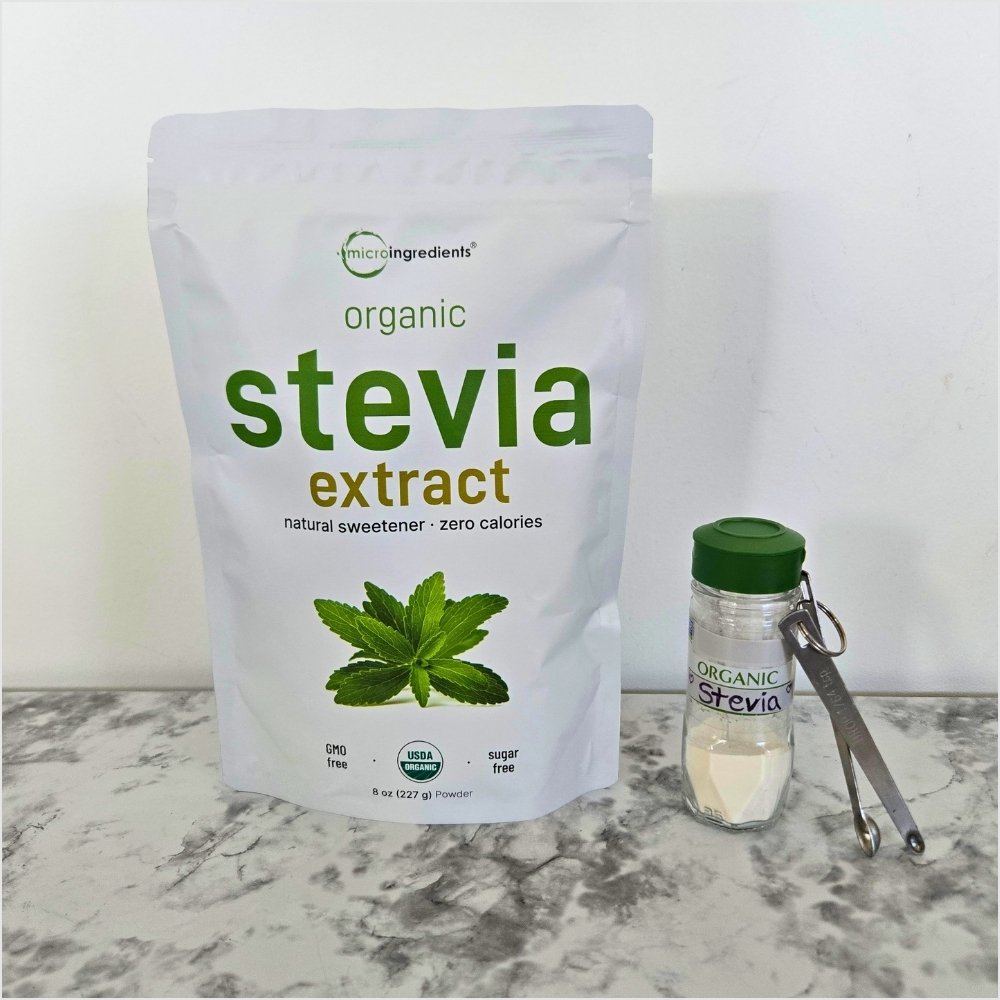
    When I want to sweeten something, I use an organic stevia extract with no fillers, made from the stevia leaf. It is so concentrated that I only need about 1/32 of a teaspoon, or 1/16 when I want it a little sweeter, so I keep it in a little glass jar with a tiny spoon. It goes in my coffee, my tea and my pickled ginger.

    A bag of organic stevia extract beside a repurposed glass spice jar labeled Organic Stevia and a set of tiny measuring spoons

    Read the label on yours. A lot of the stevia on the shelf is mostly filler, and some of it lists dextrose or maltodextrin first. Dextrose is sugar, and maltodextrin turns into sugar quickly in your body.

    When I am out and about, a couple of regular stevia packets, fillers and all, are still a better choice for me than the artificial ones. And if I know there will be coffee, like at church, I bring my own organic unsweetened coconut milk with my stevia already stirred in.

    You may be hearing about allulose on YouTube, and the early research is interesting. It is a rare sugar that tastes about 70% as sweet as regular sugar, with almost no calories, and in healthy people it barely raised blood sugar at all. But it takes spoonfuls, not a pinch like stevia, and most of what you eat is cleared by your kidneys. It has not been studied in people with cirrhosis yet. I am keeping an eye on it, and if you want to try it, ask your team first.

    And what about honey? It has real good things in it. But when I tried it, I could feel it in my liver, so I looked into why. Honey is almost 40% fructose, the same fructose again, and a tablespoon has about 16 grams of sugar. On top of that, many of us with cirrhosis handle sugar less well, because a damaged liver has a harder time storing and managing it. So what my body was telling me was right. I leave honey out.

    My answer to dessert

    My favorite place for stevia is my dessert salad. In the evening, after my first salad and some of my soup, I have my kale salad with a little stevia and some unsweetened organic coconut milk. I am still getting everything that is in the kale, and it tastes like dessert.

    Then I top off my evening with about 10 under ripe blueberries. It is a simple way to have a healthy bowel movement the next morning.

    That is my answer to dessert. Cookies, cake and other high sugar desserts are hard on a liver like ours, and there is no need for them when something nourishing can taste like dessert too.

    If your team has you on a special eating plan, like a bedtime snack or medicine for your blood sugar, follow it, and bring this post to them if you have questions.

    Why I want you to know this

    I was not careful with sugar in my early days because I did not know. Now you do.

    The best thing I know to do is feed my gut microbiome and eat what GOD gave us, before all the processing.

    And if there is something you can’t seem to put down on your own, I understand. I couldn’t put down the grapes on my own either. GOD took them away from me, and I know HE can do the same for you. HE’s done that with so many things in my life, and it is such a blessing, because it is HIS strength in us, and it’s not on our own strength.

    So talk to HIM. Maybe you don’t know HIM yet. I didn’t either, not at the start, not in the amazing way I know HIM now. You can talk to JESUS the way you would talk to someone right there in the room with you, because HE is. HE hears every word, and HE knows your thoughts before you ever say them. Ask HIM for help every time you are struggling. It can be as simple as, JESUS, please help me.

    “How sweet are your words to my taste, sweeter than honey to my mouth!”

    — Psalm 119:103 (NIV)

    May you be blessed with the knowing that HIS words are the sweetest thing we will ever taste, and may the Holy Spirit be your helper on this journey, in your health, your faith and your kitchen.

    In JESUS’ Name, Amen.

    Prayers, blessings and broccoli sprouts, 💛✝️🥦🤗
    Emily

    Know someone who needs this? Send it to them.
  • How I grow broccoli sprouts in a jar

    How I grow broccoli sprouts in a jar

    Six days ago this was two little scoops of tiny organic broccoli seeds, using the scoop that comes in the bag. That scoop is a tablespoon, so two tablespoons if you are working with your own. Today it is a jar full of flourishing, nourishing, organic broccoli sprouts, and all it asked of me was a rinse in the morning and a rinse at night.

    Here is the actual math, because I did it. A 16 ounce bag of seeds runs about $22, and 1 ounce of seeds makes about 1 jar of sprouts, so that bag is around 16 jars. That works out to about $1.36 a jar. The first time you also buy the sprouting jar, about $14, which brings that first bag to about $2.25 a jar.

    And a jar at home gives you about 4 times what comes in one of those plastic clamshells at the grocery store, which costs several dollars on its own. The freshness does not even compare.

    I have been doing this for years and I still get excited every single time.

    In my sicker days this was more than food. There is something about walking past a jar that is visibly growing before your eyes, something that is going to feed you in a few days, when the day itself has been long. It still means that to me now, and now it is also simply a rhythm I know my body is better for.

    I start a new jar about every other week. Here is how I know when: once I am down to one regular size mason jar of sprouts left in the refrigerator, it is time for day one again. It depends how many you eat, but that one jar left is my signal.

    Why broccoli sprouts, and what is actually happening

    Stay with me here, because learning this is the part that really got me excited about these little powerhouse sprouts.

    Broccoli seeds carry a compound called glucoraphanin. On its own it does nothing much. But the plant also carries an enzyme called myrosinase, and the two are kept apart until the plant is broken open. The moment they meet, glucoraphanin becomes sulforaphane.

    • glucoraphanin — gloo-koh-RAF-uh-nin
    • myrosinase — my-ROSS-in-ace
    • sulforaphane — sul-FOR-uh-fane

    I am giving you how to say them because once you can say a thing out loud, you can tell somebody else about it.

    And because those two only meet when the plant is broken open, the reaction starts in your mouth. When you crunch through a mouthful of sprouts you are rupturing those little cells with your own teeth and setting the whole thing off. So chew them well. That crunch is not just a nice texture, it is the beginning of the good part.

    And here is what sulforaphane does once it is in you. It does not go around neutralizing things itself. It goes to your cells and switches on your own defenses. It releases something called Nrf2, which travels into the nucleus of the cell and turns on a whole set of genes, and those genes build your phase two enzymes. Those are your body’s cleanup crew. They take hold of harmful compounds, neutralize them, and send them out.

    You are not eating a protective compound. You are eating the switch that turns your own protection on.

    So that’s what’s actually happening. And here’s what makes the sprouts different from a head of broccoli. Broccoli sprouts have been measured at around 7 to 12 micromoles of glucoraphanin per gram through the days you would actually be eating them. A head of broccoli from the store comes in under 1.6, and often well under that.

    That is roughly 5 to 10 times more, from something growing on your counter for a fraction of what the broccoli cost.

    And if broccoli is hard for you to get through in any quantity, a small handful of sprouts is doing a great deal of work for you.

    The broccoli tip while we are here, because I want everyone to know it

    Heat destroys myrosinase. So if you cook your broccoli, the enzyme that makes sulforaphane is gone, and most of that sulforaphane benefit is lost. Broccoli itself is still very good for you. Your gut bacteria can make a little sulforaphane themselves, but the conversion drops to around 12%.

    Here is the fix, and it takes two seconds. Sprinkle ground mustard powder on your cooked broccoli. Mustard seed carries that same enzyme, myrosinase, and adding it back has been shown to bring the sulforaphane up several times over.

    And raw broccoli sprouts on top of cooked broccoli do the same job, because they are raw and their enzyme is still intact. That is why I pile them on.

    Raw broccoli is worth a word too, because people ask. A raw head still has its enzyme, so it can make sulforaphane perfectly well. What it does not have is anything like the amount of glucoraphanin the sprouts carry. That is the whole difference. Raw broccoli has the tool and a little of the material. Cooked broccoli has the material and has lost the tool, which is what the mustard powder puts back. The sprouts arrive with both, and with far more to work with.

    What I use

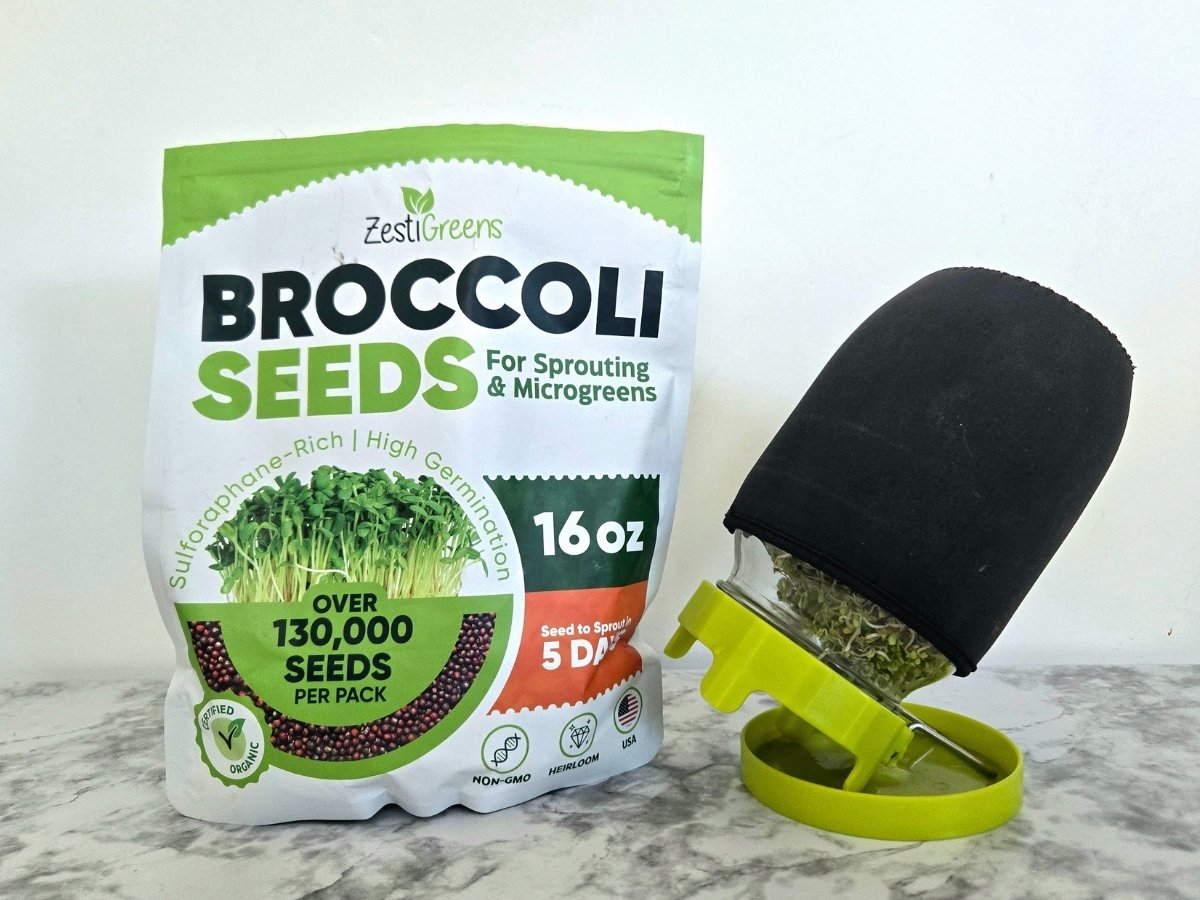
    Organic heirloom broccoli seeds. Mine are ZestiGreens seeds, and I have used them for years. I also use a wide mouth sprouting jar with a mesh lid that has a little metal stand on a hinge. It folds out and fits right into a green disc that catches the extra water. And a black neoprene sleeve.

    Organic broccoli sprouting seeds beside a wide mouth sprouting jar tilted on its fold-out stand in the green water-catching disc, with the black sleeve on
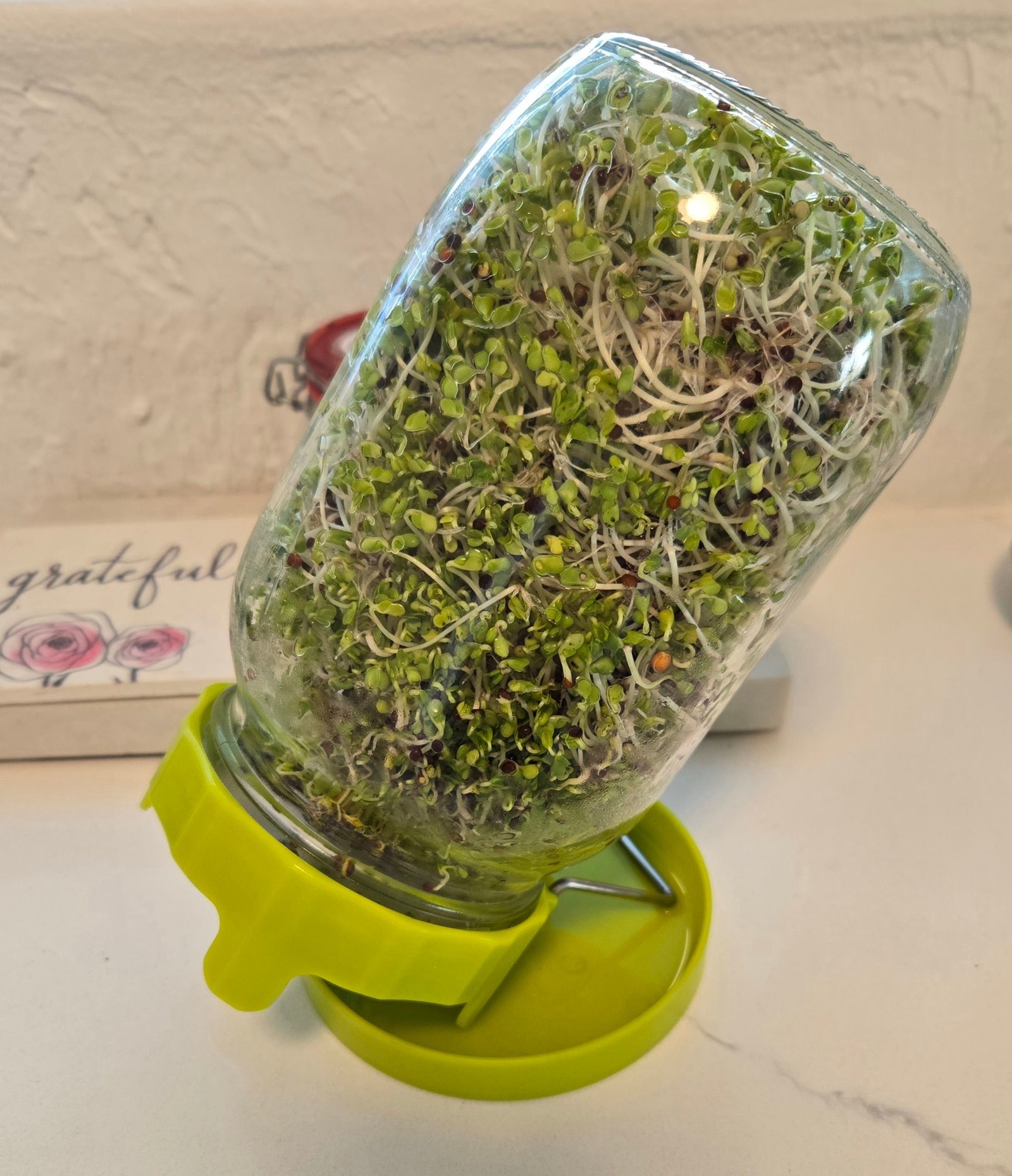
    Still covered here. Tomorrow the sleeve comes off so they can green up.

    One thing before the how-to. Seed sourcing matters more than anything else you will read about sprouting, so buy from somewhere you trust and stay with it. I use certified organic heirloom seed and I have used the same supplier for years.

    Day 1, in the evening

    I start by cleaning the jar with boiling water. Just a little, swirled around, so I know it is properly clean. Keep the sleeve on while you do it. Then leave the empty jar on the counter to cool.

    First you are rinsing the seeds. Water in, then the seeds, then top it off with more water. Put the mesh lid on, swirl, and pour the water out through the mesh. Do that 3 times. My seeds are good seeds and they do not need it, and I do it anyway.

    Now you are soaking. Fill the jar about halfway with fresh water and leave it standing upright with the water in it. Set the plastic drain tray over the top like a lid so nothing settles in while it soaks. The packet says 8 to 12 hours, and the easiest way to do this is to start it before bed and wake up to soaked seeds.

    Day 2, and every day after

    In the morning, drain it. Rinse 3 times, tilting the jar as you go so the sides stay clean. Now unhinge the stand all the way and fit it nicely into the green disc, angled upside down, with the neoprene sleeve on. If you have the same jar as me, look at the photo above.

    Do that triple rinse twice a day, and the easiest thing is to hang it on something you already do. Mine happens while my tea water is heating in the morning, and again while I am making dinner. The jar is right there on the counter, so it is hard to forget.

    The sleeve is there to keep them in the dark, because dark is where seeds want to germinate. It stays on for the first 4 or 5 days.

    Around day 4, the step no instructions include

    I have never seen this on any set of instructions, and it is the single most useful thing I have picked up.

    Take the lid off and fill the jar with water almost to the rim. Stir it gently with a clean fork.

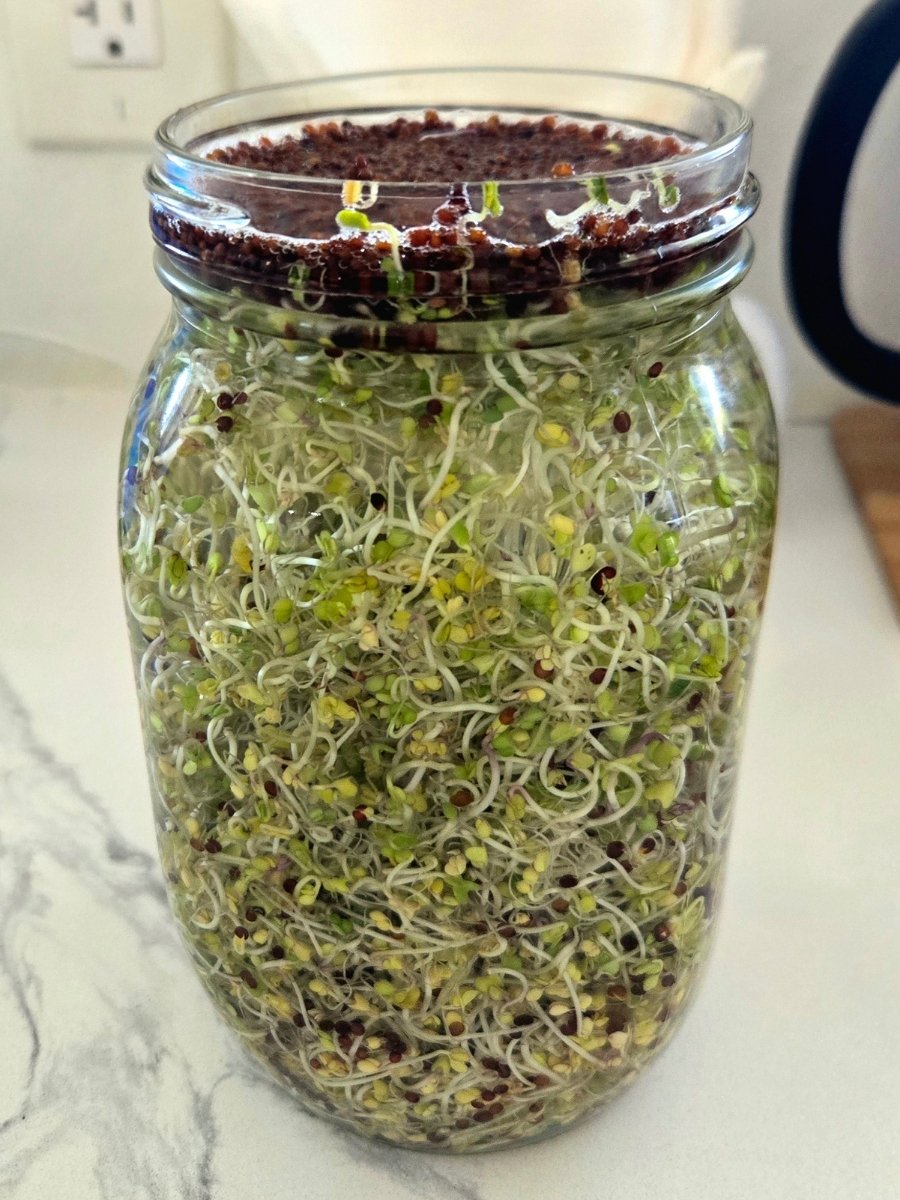
    Broccoli seed hulls floating on the water surface in a sprouting jar, ready to be skimmed off with a spoon
    Most of the hulls come straight to the top. Then you just spoon them off.

    Most of those little seed hulls float straight to the top. Take a big spoon and skim them off into the sink. Put the lid back on and do your three rinses, and if there are still hulls sitting on the lid, take it off and shake them out.

    That is it. No second dish to wash. I used to empty all the sprouts into a big glass dish, fill it with water and try to float the hulls off that way, and then I had a whole drying process on top of it. This way takes a minute, works beautifully, and the whole project stays contained in one little jar.

    Two things you get out of it. The hulls are perfectly fine to eat, this is not a safety thing, it is about keeping your sprouts as fresh as possible for as long as possible, and taking most of the hulls out makes a noticeable difference. And the gentle stirring separates the sprouts a little so they do not grow into one tight tangle, which makes everything easier at the end.

    Two things that will worry you, and should not

    Somewhere around day 3 you will see fine white fuzz on the roots and be certain it is mold. It is not. Those are root hairs. I looked it up in a panic in my early days and I would like to save you that moment.

    And if the lid ever looks like it needs washing, wash it. Go easy on the soap. You do not want soap in your sprouts.

    Around day 5, finishing them

    Take the black sleeve off and let them have daylight. They green right up, and that is chlorophyll doing its work. I harvest them on the evening of day 5, after the morning rinse, or on the morning of day 6, after the evening rinse. It is better to harvest them a little early than to let the roots grow too long. If you let them go the full 7 days, they do not stay as fresh as long.

    Keep rinsing as normal. Then, before they go in the refrigerator, let them dry. Do not put soaking wet sprouts into a sealed container. The simple way is to do a rinse and then just let them keep draining in the stand until the next rinse would have been due. If mine still feel damp when I lift them out, I put them on a plate and pat them with a paper towel first.

    I store mine in the refrigerator, in regular size mason jars, with a paper towel on the bottom and another on top.

    Sprouts do not like going hot and cold and hot again. Take out what you need and put the jar straight back in the fridge.

    How I eat them

    In my Embrobi Egg Mash every morning. In salad dressings. And when I want an afternoon boost, my go-to is cooked broccoli with raw broccoli sprouts piled on top, ground mustard powder, organic extra virgin olive oil, a little apple cider vinegar, Benson’s Table Tasty, raw organic pumpkin seeds, and nutritional yeast for the B vitamins.

    One tip if you like a smoothie. Stir the sprouts in after it is blended rather than putting them through the blades. You want your own teeth doing that work, for the reason further up.

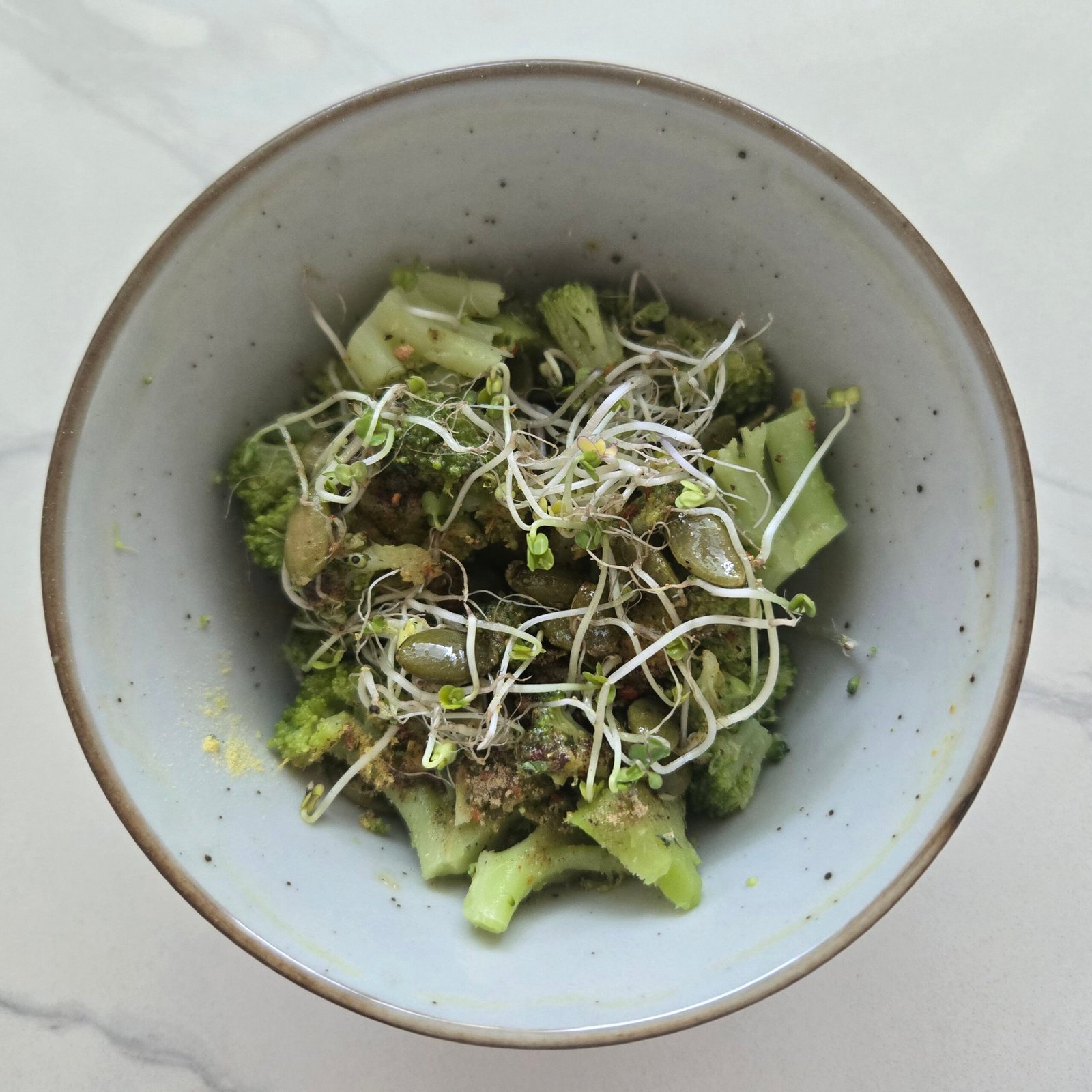
    A bowl of cooked broccoli topped with raw broccoli sprouts, ground mustard powder, olive oil and raw pumpkin seeds
    A quick one, taken right before I headed to the store. I would normally pile on more sprouts than that.

    I have a little sticky note on my refrigerator that I wrote a long time ago. It says: when having doubts, eat broccoli sprouts. And pray.

    Why I want you to try it

    In 5 to 7 days from 2 tablespoons of seed to a jar full of food, on your counter, for a dollar and change. It is fun. It is easy. And it is so much better than anything you can buy.

    I think every family should do this. I think every kid should grow up watching it happen. This is not only for those of us with liver issues. Every one of us has a liver worth looking after, and the science underneath this is real.

    And on a hard day there is something in watching a tiny seed turn into food right on your kitchen counter. Getting to watch GOD’s creation do exactly what HE built it to do, close enough to touch, has never once gotten old for me.

    “Night and day, whether he sleeps or gets up, the seed sprouts and grows, though he does not know how.”

    — Mark 4:27 (NIV)

    And this is for you.

    May you be blessed with the knowing that the One who turns a seed into food is at work in your life too, and I am so thankful HE brought you here.

    In JESUS’ Name, Amen.

    Prayers, blessings and broccoli sprouts, 💛✝️🥦🤗
    Emily

    Know someone who needs this? Send it to them.