
How to walk a grocery store
The grocery store is where all of it either works or quietly falls apart. The low sodium, the organic, the real food. Nobody teaches you this part. You get a handout that says “limit sodium,” and then you are standing in an aisle holding a jar, trying to do math while your cart blocks somebody.
So let me walk it with you. Not my stores, because we may have different ones. The way of walking it, which works anywhere.
I shop several places, and not all of them are grocery stores. There is a farm stand I go to for produce, and an Asian market that has things the big stores do not carry. Both are worth finding wherever you are.
What is in here
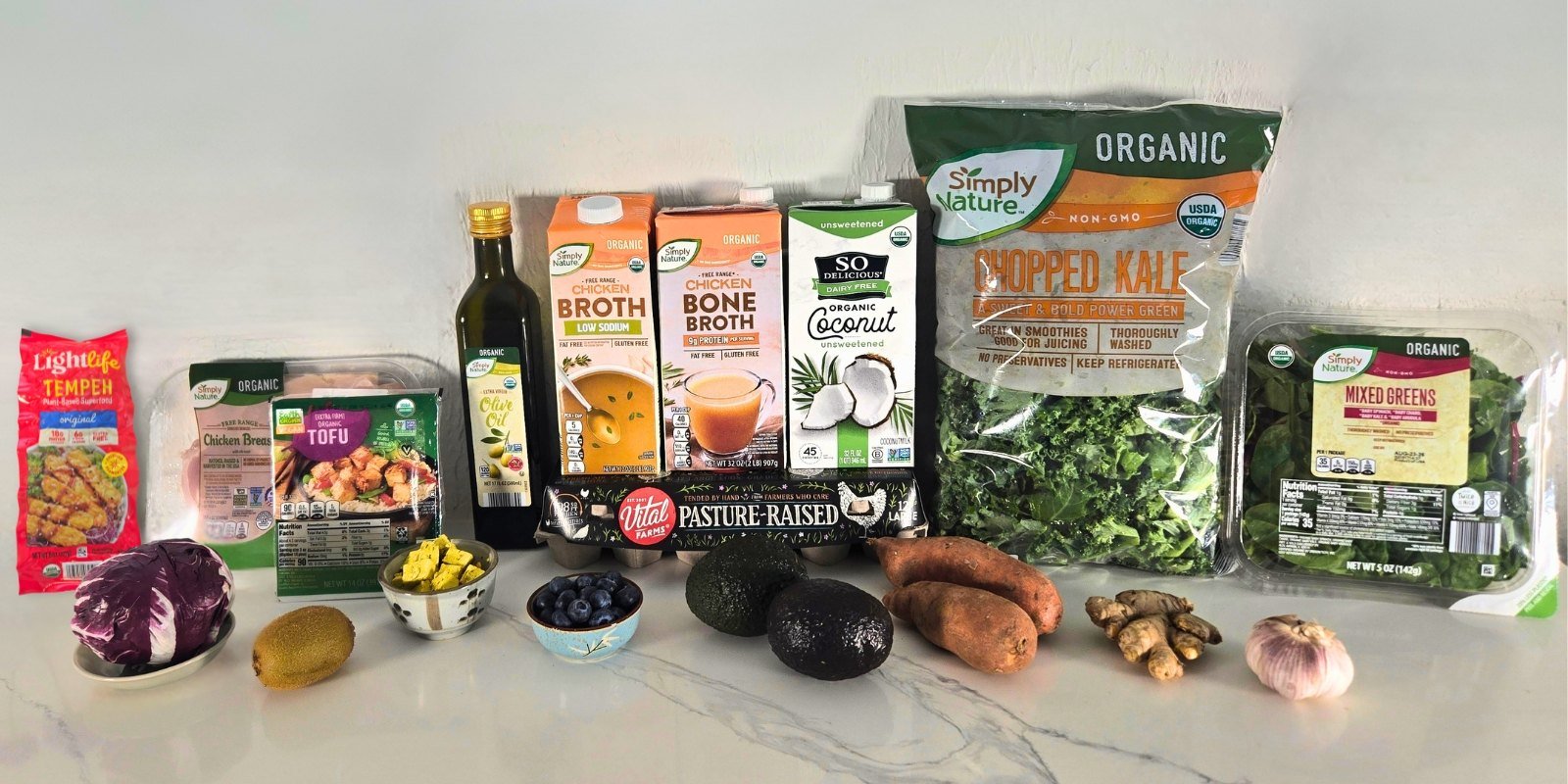
1. Produce is the whole reason to go
This is where your money and your time should go, and it is the department where you can relax. Fresh produce is naturally very low in sodium and high in nutrition, which makes it the one part of the store that is almost entirely on your side. It has also genuinely gotten better. I have been pleasantly surprised how far the big stores have come with their organic selections.
A few things I have worked out over the years, standing in that department:
The one rule that covers most fruit: under ripe. Firmer means less sugar. As fruit ripens, the starch inside it turns into sugar, so a rock-hard piece and a soft one are not the same food. That is behind nearly everything below.
I make a big salad every night, and organic kale is the base. Then I rotate. Whatever different green catches my eye at the store comes home with me, and that is what goes into the next few salads. Mustard greens one week, bok choy the next, then beet greens, turnip greens, radicchio, or a bag of mixed organic greens. Whatever you are in the mood for that week. Every one of them brings something exciting and different.
Buy kiwis hard, and eat the skin. I go for the green ones. The golden ones are too sweet for us, and the green ones carry more of an enzyme called actinidin, which helps you break down protein. The skin is where a lot of the fiber is, so do not peel it. I have half of one each day.
If you buy bananas, buy them green, and only a few at a time. They will not stay green long. The green ones still have their resistant starch, which feeds your gut microbiome, and that starch turns to sugar as they ripen. I usually have half a banana rather than a whole one. I do not want to overdo it.
Organic blueberries, and the other berries too. We are keeping sugar low, and berries still earn their place because of the fiber that comes with them. Raspberries and blackberries bring the same thing, along with the polyphenols that give berries their color and do the antioxidant work. In moderation, organic when you can find them. They are lovely stirred into kefir.
Cranberries! Every year when I first spot them on the shelf I make it known. I buy organic when I see it, and when I can tell the season is ending I freeze them, so I still have them for soup and for cranberry sauce long after they are gone from the store. They are low in sugar for a fruit, the polyphenols in them are food for the good bacteria in your gut, and they are the best studied thing there is for urinary tract health.
Ginger. Get it, and organic if you can find it. This is one where I would rather you had ginger than skipped it because the organic was not there. Walmart carries it organic, which is not always easy to come by, and it is one of my favorite farm stand finds. I keep some in my bag and snack on it raw through the day.
Lemons, limes and grapefruit. Acid wakes food up in a way salt never did for me, and these three do most of that work. If you plan to use the zest, buy them organic. The peel is where the sprays sit, and zesting a conventional lemon puts all of that straight into your dinner.
Garlic, onions and chives. They are the allium family, and the sulfur compounds that give them their bite are the same ones that make them good for you. They add real depth to a dish. Buy more than you think you need.
Look around while you are in there. Rapini, if you have never tried it, it is so delicious. Radishes. Anything you have walked straight past a hundred times. Produce is the one department where nearly everything in front of you is something you can have, and that is worth a few extra minutes.
And know where the sugar hides. Produce is the safest department in the store, but not all of it is the same. Grapes are the one that caught me. Early on I ate an enormous amount of them, before I understood how much sugar I was really having. Oranges and most tropical fruit sit at that same sweet end. None of that is a reason to fear fruit. It is just worth knowing that the sugar in the healthiest looking aisle still counts.
Avocados are a healthy fat. I have about one a day, spread between breakfast, lunch and dinner. They have a tough skin and they are not on the Dirty Dozen, so this is one of the places I do not always buy organic. I would rather you knew that, so you can put your money where it counts most for you.
2. Read past the front of the box
You have already put the salt shaker away. Here is what nobody warns you about: the salt keeps coming anyway, because most of it was never in the shaker. It was in the food before you carried it through your door.
This is the one that fools everybody, and it is the first thing I would tell you about a label.
You cannot go by “reduced sodium.” Reduced sodium is still way too high. What you are looking for is unsalted, or no salt added.
“Reduced” only means less than the original version, and the original version may have been enormous. It is a comparison, not a standard. “Low sodium” is a little better because it is a defined label, but here is the catch: a lot of products that carry it use the full amount that label allows, right up to the line. So I still turn the jar over. Every time.
And they stack. Put three or four things on one plate that each sit right at the top of what the label allows, and you have spent far more than you meant to. So it is worth being thoughtful about what you put together, not only about what you pick up.
Here is what those words actually mean, because nobody hands you this.
In the US, “low sodium” is a defined claim: 140 mg or less per serving. That is a ceiling, not a target, and plenty of products sit right up against it.
In the UK, the labels show salt rather than sodium, which is its own trap. “Low salt” means 0.3 g of salt per 100 g, and it is the green traffic light on the front of the pack. To get sodium from salt, divide by 2.5.
“Unsalted” and “no salt added” are a different thing from both. They mean nobody put salt in. They do not mean there is none in there, because plenty of food carries a little sodium of its own. That is not the sodium I worry about. It is just worth knowing what to expect before you count on something.
Turn it over. Read the actual number. That is the whole rule.
And check it against what you will actually eat. The number on the panel is per serving, so look at what they decided a serving is. With salad dressing the listed serving is usually far less than what any real person puts on a real salad. Same with hot sauce. Do the honest math for the amount you are actually going to use. Sometimes a product that looked fine doubles or triples once you are truthful about the pour.
Canned beans are worth turning over. I buy organic canned beans and chickpeas, and the sodium runs wildly different from one brand to the next. In the bigger stores you will often see it said outright, organic low sodium or organic no salt added. Mine come from Aldi, and they are low even though the can does not say so.
Rinse them either way. Tip them into a strainer, run fresh water over them, and a good share of the sodium goes down the drain with it. I find they sit easier on me too, especially the black beans.
And if you have the time, dried beans that you soak and cook yourself are better still. Organic if you can find them, which is easier online than on a shelf, and they cost next to nothing.
3. The ingredient list matters
The panel tells you about the sodium. The list underneath it tells you what the food actually is.
Start reading that list and it is shocking. Maltodextrin. Preservatives you would never spoon into a bowl on purpose.
And I care about this beyond the number. The more a food has been processed, the further it is from the form it was given to us in, and the harder our bodies have to work to make sense of it. Your liver does that work, and it is already carrying plenty. Every time we hand it something it was never built for, we are asking it to stop what it was doing and deal with that instead.
So the ultra-processed, the high sodium and the preservatives are what we steer around. And here is something refreshing: it makes the store smaller. You do not have to walk down the chip aisle anymore, or the cookie aisle. There are whole crowded sections you never have to push a cart through again, and you save money not buying any of it.
This is the part I care about most, and it is the part that took me longest to learn. Low sodium on its own was never the goal. What I am looking for is food that is still recognizable as food, made of things I could name out loud. If there is an organic version of what I am reaching for, that is the label I read first.
Organic, wherever I can get it. I would buy everything organic if I could, and I get as close to that as I can manage. It is about nourishing my liver rather than handing it something harsh to deal with.
Glyphosate is a big one. It is the weedkiller in Roundup, it is sprayed across a great deal of conventional food, and it is not something I want inside me. Our gut microbiomes and our livers already have plenty in front of them without it.
And here is something very encouraging. It does not take long. In one study, people who switched to organic food saw the glyphosate in their bodies fall sharply within days. Not months. Days. So any step you take toward organic is doing something.
You will not find everything organic, and some of it will cost more than you can spend. Please do not let that stop you eating vegetables. A conventional vegetable is far better than no vegetable, and every organic one you do find is that much less for your body to handle. Do what you can, where you can. Everything your body does not have to deal with is strength it gets to spend on repairing you instead.
And do not be put off when it looks like it had a hard life. A bug hole. A mark. A shape that would never make the cover of anything. When a plant has to defend itself, it makes more of its own protective compounds, and polyphenols are among them. The one that had to work a little harder can be the better one, and all of that goes into you.
That is not the same as bruised, soft or spoiled. Put that back. And organic produce often will not sit as long on your counter, so buy what you will actually eat this week.
The little army in your gut is your gut microbiome, the colony of microbes living inside you and working on your behalf. Preservatives do not feed them. Preservatives harm them. What they want is the food GOD designed for them, and they do their best work when they get it.
Take peanut butter, which looks simple enough. I have picked up every jar on a shelf looking for one that was just peanuts, organic, no salt, and most of them had palm oil in them. What you want is organic peanuts and nothing else, and do not be reassured when the label says organic palm oil, because that is still not what you want. The back of the jar will tell you all of that, if you turn it over.
The frozen dinners are the clearest case of all. One small tray, an enormous amount of sodium, an ingredient list as long as your arm, and you are still hungry afterward.
I would rather the sodium I do have come from food than from a factory.
4. Feeding your gut
Shop for the little army inside you.
I do not only shop for me. I shop for the microbes in my gut, because when I feed them what they actually want, they get to work on my behalf.
Two words worth knowing, and they are simpler than they sound. Probiotics are the microbes themselves. Prebiotics are the food you give them. You want both in the cart. One brings the workers, the other feeds them.
Kefir is how I bring the good bacteria in. Plain, unsweetened, organic, 100% grass fed. Mine is Maple Hill. Kefir carries more live cultures than yogurt does and more kinds of them, which is why it is my one and not just my convenient one. A little goes onto my first salad of the night, and stirred with a fork along with Benson’s Table Tasty, which is on my shop page, it turns into something close to a creamy ranch.
Yogurt has some probiotics too, so plain unsweetened yogurt is worth having. Not the sweetened kind, and not the fruit-on-the-bottom kind either. That fruit was picked ripe to start with and then cooked down, which concentrates the sugar before anybody adds more. Stir in your own berries instead.
If dairy is hard for you, I understand it. I am lactose intolerant, and kefir does not bother me the way milk and cheese do, though I still take a dairy pill with it to be careful. When I want yogurt I usually reach for coconut milk yogurt instead. Check that the label actually says live and active cultures, because some are pasteurized after fermenting and there is nothing living left in them. Soy yogurt is out there too. I skip it because I already get plenty of soy from tofu and tempeh.
And here is the trap: the fermented foods everyone recommends, sauerkraut, kimchi, miso, pickles, are nearly all high in sodium. That is why kefir ended up carrying this for me.
There are probiotic supplements as well. I was told I could take them, and I think they may have helped build up that army inside me, along with consistently feeding them what they need to thrive. Starting one is still a conversation for your own team first.
For feeding the gut microbiome, and because it is delicious, I buy cruciferous vegetables. This is so important! Broccoli. Cabbage. Bok choy. Cauliflower. Brussels sprouts. Kale. You are going to hear me say all of this again.
Broccoli is the one I owe the most to, and one rule goes with it: add ground mustard powder. Cooking broccoli destroys the enzyme it needs to make sulforaphane. Mustard seed carries that same enzyme and it survives the heat, so a sprinkle of ground mustard powder on cooked broccoli puts the conversion back. Broccoli sprouts do not need it, because raw sprouts still have their own. When I was very sick I asked the nutritionist whether I could have broccoli, and she told me I could have as much as I wanted. So I ate it every single day, bulk frozen, straight through the pandemic. I did not know the word sulforaphane then. I just knew it was green, it was filling, and it was something I could do for my body when there was very little I could do. I still keep bags of frozen organic broccoli on hand, always.
I grow broccoli sprouts on my counter now. When your teeth crunch through them, that is what activates the sulforaphane, so chew them properly.
I use those same seeds in my garden too. I plant them and I do not wait for the broccoli, because the leaves come in huge and lush and packed with nutrients, and I cut them right into my salad. You can’t buy broccoli leaves at the grocery store, and they have been one of the most exciting garden blessings I have had.
If a lot of broccoli feels like too much fiber at first, start smaller. That bloated feeling caught me off guard once and I wondered whether it was ascites. It was not. Your gut simply has not met that much fiber yet, and it does catch up as the army grows.
That is also why the kefir belongs in the cart right next to the broccoli. Prebiotic fiber is food, and food works best when there is a colony down there ready to eat it. Bring the workers along with the food, and go slowly with both.
Go slow if you need to. Smaller portions of broccoli and other cruciferous vegetables, build up gradually, and let the kefir help. Add kale too. Organic green kale comes ready cut in a bag at almost every store, and a mix of broccoli and kale is a good place to start.
Sulforaphane supplements exist too. Sulforaphane is the compound we are actually after, and food is the better way to get it, which is where mine comes from. But if you cannot get enough from sprouts and cruciferous vegetables in the beginning, there is nothing wrong with asking your team about one.
And you do not have to do all of this at once. Pick one thing off this page for your next trip. The rest of it will still be here.
5. Protein, and the advice that changed
When I was diagnosed, I was told to keep my protein low. I did what I was told for a long time. That advice has since turned around, and it turned around for a good reason: restricting protein did not protect anyone the way it was meant to, and it cost people their muscle.
I did not learn that from any announcement. I got better, and I started putting protein back in small pieces long before anyone told me anything had changed. Nutritional yeast on things. A collagen peptide powder in my morning coffee and my daytime tea, which is on my shop page. Little bits, here and there. Now I pay real attention to it, and I go to the gym to build muscle on purpose.
Muscle is not vanity when you have cirrhosis. It is one of the things worth protecting. If you were told to go low on protein, that advice has moved since. Ask your own team what is right for you, because it depends on you and on your history.
Tofu and tempeh, organic. Both are in my rotation, and both take on whatever flavor I give them.
Fish, and salmon most of all, for the omega-3s. Fresh catch is worth going out of your way for. When I order fish out I ask for it grilled or pan seared, plain, with lemon wedges on the side. I bring my own Benson’s Table Tasty.
I keep low sodium salmon in a pouch around too, for when I want more protein without cooking anything. Sometimes I eat it just as it is. Sometimes it is another hard boiled egg instead.
Organic chicken. This is my go-to when I want to add protein to a day. A little olive oil and some spices, into a glass dish, about thirty minutes in the oven, and it is done.
Organic ground turkey and chicken for anything that starts with browning meat in a pan.
Beef, 100% grass fed and organic. A cow that has been able to roam and feed lives better, and I believe that shows up in what you are eating. I buy both steak and ground. Ground beef is simply handy, because there are things you are not going to make with a steak, and I have recipes I use it for. One thing worth knowing while you are standing there: ground beef comes from many cows, and a steak comes from one. Worth knowing, not worth worrying about.
Eggs, and the one rule is happy hens. A hen with a good life lays a better egg. Read the carton while you are holding it and get familiar with what it actually says. This is the order I go in:
Organic and pasture raised together. The best you can do.
Pasture raised. I will take plain pasture raised over organic free range every time, and I do. The numbers are startling. On a Certified Humane carton, free range means at least 2 square feet of outdoor space per hen. Pasture raised means 108.
Free range. Better than no outdoors at all, and usually not expensive. But a free range hen can still be eating nothing but grain, even organic grain, and it is the foraging that makes the difference.
Whatever you can actually get. Regular eggs are still better than no eggs. Do not let the best one stop you from having any.
Omega-3 eggs are a different kind of upgrade, since that is about what the hen was fed rather than how she lived. Worth a look if none of the above are there.
My favorite egg brand is Vital Farms. I have emailed with them over the years and they are a great team. They visit their farms and they care about it.
I hard boil a batch so I can have one every morning, and I draw a line on the carton with a permanent marker to show which side is hard boiled.
And the rule from the eggs runs through all of it. I want animals that had a good life.
6. Fats, acids, and the rest of the pantry
Take the salt out and food does not become flavorless. It becomes flavorless if you do not replace what the salt was doing. Salt was carrying flavor and waking things up. Fat and acid do that job, and they do it better.
One of the biggest mistakes I made was about fat. My cirrhosis came out of fatty liver, so I decided fat was the enemy and I barely ate any for the first couple of years. That could not have been more wrong. Your body needs fat. Your skin needs it, your muscles need it, your organs need it, and going without did me no good at all.
Organic extra virgin olive oil. I buy mine at Aldi and at Walmart, and I look for the dark glass, because light is hard on the oil. Extra virgin means it was pressed without heat or chemicals, which is what keeps the polyphenols that make olive oil worth eating in the first place. And here is something it took me a long time to find out: cold pressed and extra virgin are the same thing. If a bottle tells you both, it is not telling you anything extra.
Vinegar, and more than one kind. Organic apple cider is the one I reach for most, and mine is Bragg’s. It does my pickled habaneros and my tri-color peppers. Organic rice vinegar does my pickled ginger. Plain white does some of the rest, and I keep malt on hand for my salad. Acid is what you turn to when something tastes flat, and it is the fastest fix in the kitchen.
Organic spices, and watch the per ounce price to find the deals. I buy a lot of mine in bulk at Sprouts, and I order online when the deal is better there. Buying bulk and refilling the glass jars you already have beats replacing little jars forever. Spices are doing a great deal of the work in my kitchen now, so they are worth a minute of attention.
Benson’s Table Tasty. No salt, no potassium chloride. I cooked without it for my first couple of years and the food was genuinely good, because real food tastes like something once you can actually taste it. This is when everything got even more lively. It is on my shop page, it is in my cupboard, and it is in my lunch bag in case Jason, my fiancé, and I stop somewhere to eat.
Organic chicken bone broth. Mine is from Aldi and it is genuinely low in sodium even though the carton does not say so. In plenty of other stores you will see it stated outright, no salt added or unsalted. Turn it over either way. And check which one you are holding, because the beef version at my store is far too high.
One thing that will do more for you than any recipe. If something tastes flat, it usually needs acid, not salt. Reach for the vinegar. That is the reflex to build, and once you have it you can bring almost anything back to life.
“Then GOD said, ‘I give you every seed-bearing plant on the face of the whole earth and every tree that has fruit with seed in it. They will be yours for food.’”
— Genesis 1:29 (NIV)
7. When a label brags about what is missing
No salt added. Sugar free. Fat free. Every one of those tells you what was taken out. Not one of them tells you what went in instead. That is where I have been caught, and once it was serious.
Potassium chloride is the one that nearly got me. I was using a salt substitute called NoSalt. I even brought the canister in and showed my doctor, and I was told it was fine. Then a blood test came back with my potassium in the heart attack range, and he called me while I was standing in the Aldi parking lot to make sure I was alright.
Here is the part nobody had told me. Potassium chloride is what a lot of salt substitutes use in place of salt, and I was taking spironolactone, which is a diuretic that holds on to potassium. The two of them together are a real problem. My sister Shannon is the one who found me Benson’s Table Tasty, and that changed everything.
And it is not only in the salt substitutes. I have found a no salt added ketchup on a shelf with potassium chloride in it. That is the trap inside the trap, because “no salt added” is exactly the phrase I have been telling you to look for.
So turn it over and read the ingredients, every time. If you see potassium chloride, put it back on the shelf.
Sugar free is the same trick in a different aisle. I went through a stretch early on of buying sugar free candies, and I could not tell you now what I thought I was accomplishing. Take the sugar out and something has to replace it, and what replaces it is usually a list of things I would not choose to eat. The label told me what was gone and said nothing about what had arrived. What I use instead is an organic stevia extract with no fillers, which is on my shop page, and I keep it in a little glass jar with a tiny spoon. Most of the stevia sitting on the shelf is mostly filler, and that is the same trick one more time. When we are out, a stevia packet is still a better choice than the colored packets on the table.
8. Photograph what’s in it, don’t buy it
This added a whole new level of fun to my shopping, and it is still my favorite thing I do in a store.
When I find something on a shelf that sounds delicious and is loaded with sodium and preservatives, I do not put it back sadly and walk away. I take a picture of the ingredient list.
Then I go home and make it. Without the salt. Without the preservatives.
Then I go home and make it. Without the salt. Without the preservatives. That is how my mustard happened. That is how my hot sauces happened. The store stopped being a list of things I cannot have and turned into a recipe library. Every jar on every shelf is somebody’s idea, and ideas are free.
9. The pickle aisle is for inspiration
For years I would not walk down the pickle aisle. It was too discouraging. Everything in it was off the table and there was no point standing there feeling sad about it.
By then I had already started pickling my own. Habaneros, jalapeños, tri-color peppers, anything I wanted. Then one day it dawned on me that I could do right here what I had been doing everywhere else in the store. I did not have to avoid this aisle. I could walk it for ideas.
Now I walk it on purpose. Anything I see in there that I want, I go home and make myself, my way, with vinegar and spices and no salt at all. It is fun to look and see what they have. Not to buy, of course.
The pickle aisle is always just good for inspiration, for whatever you want to create in your very own kitchen.
10. Nobody’s store has everything
I do not get everything in one place, and you will not either. That is not a failure, that is just how this goes.
My main stores are Publix, Aldi and Walmart, and I go to each one for different things. Publix is where I get my kefir, my tempeh, and organic blueberries, the GreenWise ones. Aldi is where I get tofu, organic beans, organic chicken, chicken bone broth and a lot of my produce. Walmart has a better organic selection than people expect, including the coconut milk, plenty of organic vegetables, and a bag of organic sweet potatoes I like. Then there is the farm stand and the Asian market I mentioned at the top, and Sprouts when I am going a little farther, usually when I have an appointment down that way. Their produce is wonderful and it is where I buy my spices in bulk.
It took me a while to learn what to get where, and I never once found it a hindrance. It was an exploration, and I learned a great deal doing it. Now it makes sense to me. There are gems at each one, it is more walking, and it is more chances to meet people and tell them what GOD has done in this journey.
After a few trips you will know what goes on which list, and then you have it forever.
Before you go
Use your store’s app as a little treasure map before you leave the house. Search “unsalted,” “no salt added,” “low sodium organic,” “unsweetened organic,” “pasture-raised.” Save a few finds to your list.
And the foods you are switching to are often not in the aisle you would guess. At one of the stores I go to, the organic unsweetened coconut milk is not with the milk at all. It is next to the lemon juice. I asked more than once and nobody working there knew either. So search the app instead of the shelf.
Then go walk the aisles anyway and explore. Some days I go in with a mission, and it is not a shopping list. Today I am going to read every label in the hot sauce aisle. Today I am going to look properly at a shelf I have walked past for years. Once you are looking for different things, it starts to feel like a whole new store. Quieter. Simpler. Full of real food you have walked straight past for years.
One more thing, and it is not about food. Going to the store is itself a small piece of movement, and I count it. You could have all of this delivered, and some days that is the right call. But if your body will give you the trip, take it. The walking, the reaching, the standing and looking, it all counts for something. It is good to get up and move around and get your blood circulating, and this is gentle.
Some days the trip is too much. That depends on where you are in this, and it changes. On those days, order it or let somebody go for you. And if you do, ask for the produce under ripe, because whoever is picking for you will not think of it.
Then let the kitchen be your moving instead. There is always something in there to stir or start.
A short trip is still a trip. And on the days you do go, have so much fun and enjoy the adventure.
Thank You, GOD, for the food You made for us!
Come along with me
Recipes, what I am learning, every new exciting thing I find, and the moment the YouTube channel goes live, the community opens, or the book is ready. I would love to have YOU here for it.
“HE makes grass grow for the cattle, and plants for people to cultivate— bringing forth food from the earth.”
— Psalm 104:14 (NIV)
I am not a doctor. I am a patient who has lived this and paid very close attention, and none of it is medical advice. What I share through Embrobi is what carried me from end-stage liver disease to thriving with cirrhosis. Your numbers are yours, so take this page to your own team and ask them whether it is a good fit for you.
May your kitchen be filled with flavor, joy, and the good food GOD created for you.
Prayers, blessings and broccoli sprouts, 💛✝️🥦🤗
Emily
Know someone who needs this? Send it to them.